
Five Ways Neurofeedback Can Boost Focus for College Students
College is a pressure cooker. You're juggling coursework, part-time jobs, relationships, and a sleep schedule that's been quietly falling apart since orientation week. You sit down to study and your brain just won't cooperate. You read the same paragraph three times. You get up to grab water, open your phone, and twenty minutes disappear.
This isn't laziness. For a lot of students, it's a brain regulation problem, and that's something we can actually work with.
As busy students, having quality time studying can greatly improve academic outcomes. Neurofeedback for focus is a brain-training approach that uses real-time EEG data to help your brain learn more efficient patterns. It's not medication. It's not talk therapy. It's a targeted, evidence-informed process of teaching your nervous system to do what you need it to do. I offer both in-person and remote neurofeedback sessions out of my practice in Edmond, OK, and I've worked with students from the University of Central Oklahoma, Oklahoma Christian University, and students who go to schools across the country during the summer.
Here are five concrete ways neurofeedback can help you focus better, study smarter, and get through the semester without running on empty.
1. It Trains Your Brain to Stay in a Focus State
Your brain produces different types of electrical activity depending on what you're doing. When you're focused and alert, you're generating beta waves. When you're drifting, daydreaming, or mentally checked out, theta activity tends to dominate. Many students who struggle with concentration have too much theta relative to beta, particularly in the frontal regions that govern attention and decision-making.
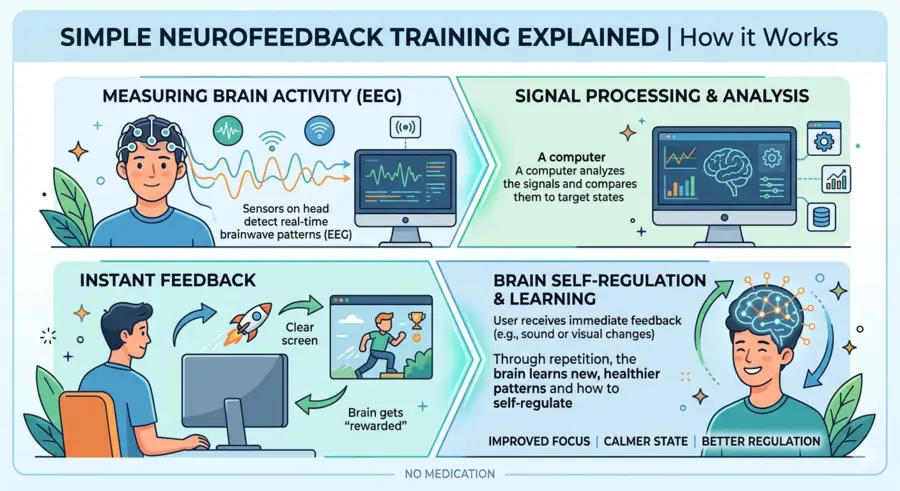
During neurofeedback training, you receive real-time feedback about your brainwave activity, typically through auditory or visual cues. For focus and concentration training, that feedback is tied to your ability to maintain brainwave patterns associated with heightened attention, like increased beta wave activity in the frontal cortex.[2]
What does that look like in practice? You might watch a video or play a simple game that responds to your brainwaves. When your brain produces the patterns associated with focus, the video plays clearly or the game rewards you. When it drifts, the feedback changes. Over repeated sessions, your brain learns to spend more time in the states that actually support sustained attention.
Neurofeedback for focus is one of the oldest trainings for neurofeedback, so it's safe and effective. Before I design any protocol, I start with a QEEG brain map so I can see exactly which frequencies are dysregulated and in which regions. That's what makes the training precise rather than generic. The goal isn't just to feel calmer; it's to train the specific patterns driving your specific focus problem.
2. It Quiets the Mental Noise That Competes with Concentration
One of the biggest focus killers for college students isn't a lack of attention — it's an overabundance of competing thoughts. The paper due next week. The conversation you replayed at 2 a.m. The low-grade anxiety that sits behind every task and makes everything feel slightly more urgent than it needs to be.
Research shows that increasing alpha wave activity through neurofeedback training has been linked to improved relaxation and reduced arousal, which are crucial in high-anxiety states commonly experienced by university students. Alpha waves also play a role in inhibiting distracting stimuli, enhancing cognitive focus and information retention.[1]
Think of alpha activity as your brain's noise-canceling function. When it's calibrated well, irrelevant information gets filtered. You can sit with the task in front of you instead of being pulled in five directions.
A 2024 study on neurofeedback training with university students found that it showed significant potential not only in cognitive enhancement but also as a tool for anxiety management in stress-prone academic environments.[1] That matters because anxiety and focus don't coexist well. When the brain is busy managing threat signals, there's less capacity for the kind of sustained, deliberate attention that studying requires.
For students dealing with both concentration difficulties and chronic worry, addressing the underlying dysregulation rather than managing symptoms surface-level can make a meaningful difference. Every person's brain signature looks different, so the approach I use in sessions is always tailored to what the data shows.
3. It Can Improve Working Memory — Which Drives Academic Performance
Working memory is your brain's mental whiteboard. It's where you hold the information you're actively using, whether that's the argument in the article you're analyzing or the formula you're applying in real time on an exam. When working memory is compromised, everything downstream suffers: reading comprehension, problem-solving, test performance.
Some studies show that students who underwent neurofeedback improved their working memory, making it appealing not just for therapeutic purposes but also for boosting mental sharpness.[3]
Neurofeedback doesn't directly inject information into your brain. It supports the underlying neural systems that make information processing more efficient. When your brain is better regulated, working memory tasks require less effort. You can hold more in mind at once, which means you're not losing threads mid-lecture or mid-problem set.
This is particularly relevant for students who notice that they understand material when they're studying in a calm, low-pressure setting but then struggle to access it under the conditions of an exam. That gap between what you know and what you can retrieve is often a regulation issue. A QEEG-guided neurofeedback protocol can help identify what's driving it and build a training plan specific to your brain's needs.
For college students, this connection between brain regulation and academic performance is worth taking seriously. I'm BCIA-certified in neurofeedback, which means the protocol design and progress monitoring meet professional standards, not just general wellness claims.
4. It Supports Better Sleep, Which Makes Everything Else Work
You already know sleep matters. You've heard it a hundred times. But knowing it doesn't help when you're lying awake at midnight before a 9 a.m. exam or when your schedule is so compressed that seven hours feels like a luxury.
What's less commonly understood is that disrupted sleep and poor cognitive performance aren't just correlated — they run on the same neural systems. Research on college students showed that sleep deprivation impairs working memory capacity and alters the brainwave patterns associated with cognitive processing.[5] Poor sleep dysregulates the very brainwave activity that drives focus and memory. And when you're already operating on a dysregulated nervous system, even adequate sleep doesn't fully restore you.
Neurofeedback can target the brainwave patterns involved in sleep onset and maintenance. Students dealing with racing thoughts at bedtime, difficulty winding down, or sleep that doesn't feel restorative often have identifiable patterns on a QEEG that point to where the problem lives. Training those specific areas can help the brain transition more naturally through the sleep stages that matter for memory consolidation and cognitive recovery.
If you're a college student who feels perpetually fatigued no matter how much you sleep, that's worth paying attention to. It's not just a willpower problem or a time management problem. In many cases, it's a nervous system problem, and neurofeedback is one of the few approaches that addresses it at that level.
5. It Builds Cognitive Resilience Over Time — Not Just in the Moment
Here's what makes neurofeedback different from a lot of other focus strategies: the effects don't stop when the session does.
Caffeine, stimulants, even some cognitive training apps — their benefits are largely situational. You use them, you feel more focused, the effect fades. Neurofeedback is designed to shift the underlying patterns in the brain itself. Studies have demonstrated that neurofeedback training for focus and concentration can lead to lasting improvements in attentional abilities, with benefits persisting beyond the training period.[2]
This matters a lot for college students who need to function consistently across a semester, not just on good days. Lectures, late-night study sessions, midterms, finals — the demands are relentless and they require a brain that can sustain effort over time. Neurofeedback is less about giving you a boost and more about raising your baseline.
Over time, the brain learns healthier patterns, much like muscle memory from exercise. Based on neuroplasticity — the brain's ability to rewire itself — neurofeedback helps people improve focus and reduce stress through sustained training.[2]
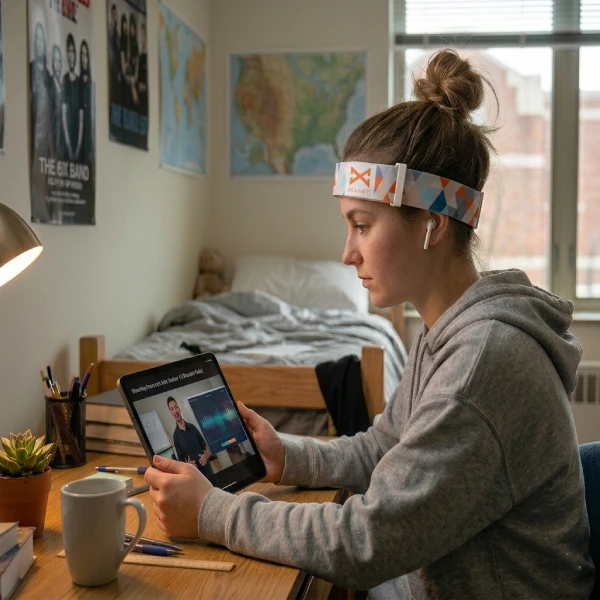
It's easy to train in your dorm in between classes or after classes are out for the day. For students preparing for graduate school, professional programs, or high-stakes career transitions, building that kind of durable cognitive capacity is a real investment. Sessions are available both in-person at my Edmond, OK office and remotely, so access doesn't have to be a barrier to getting started.
Key Takeaways
- Neurofeedback uses real-time EEG data to help your brain produce patterns associated with focused attention, reducing the theta-dominant drift that pulls you off task.
- Alpha wave training reduces mental noise and anxiety, freeing up cognitive capacity that worry and distraction typically consume.
- Working memory — the system you rely on in lectures and exams — can improve with targeted neurofeedback training.
- Sleep quality and cognitive performance are closely linked; neurofeedback can address the dysregulation that disrupts both.
- Unlike symptom-level focus strategies, neurofeedback builds lasting change by training the brain itself, not just masking the problem.
- QEEG brain mapping allows me to identify exactly which patterns need work in your brain, making the training specific rather than one-size-fits-all.
- Both in-person and remote neurofeedback options are available for college students in and around Edmond, OK.
Is Neurofeedback Right for You?
If you've tried adjusting your habits, your schedule, your environment, and you're still hitting a wall with focus, it may be time to look at what your brain is actually doing. A QEEG brain map is the starting point. It gives us a clear picture of your brainwave activity and identifies what's driving your specific challenges.
I work with college students and young adults from my private practice in Edmond, and I offer both in-person sessions and remote training options for ongoing work. I've worked with students from the University of Central Oklahoma, Oklahoma Christian University, and students attending schools across the country — the flexibility of remote training makes that possible. If you're curious about what neurofeedback could mean for your academic performance and overall mental sharpness, reach out and ask about the process.
You can also read more about how neurofeedback works on my neurofeedback services page.
Ready to find out what your brain is actually doing?
Schedule a QEEG brain map and take the first step toward focused, sustained attention that lasts beyond the semester.
Frequently Asked Questions
The number of sessions varies by person because every brain is different. Most people start to notice meaningful changes somewhere between 10 and 20 sessions, with continued improvement over time. The QEEG map I do at the start helps us set a more individualized roadmap based on what your brain is actually showing us. This isn't a standard protocol applied to everyone.
QEEG-informed selection of neurofeedback protocols has been associated with improved training outcomes for attention-related difficulties.[4] Neurofeedback is often used alongside or as an alternative to medication, depending on the individual's situation and goals. I don't prescribe or advise on medication, but I can provide targeted training based on your brain map. Whether you're medicated, unmedicated, or somewhere in between, the training is adapted to what your data shows.
A QEEG, or quantitative EEG, records your brain's electrical activity from multiple sites across the scalp. It's non-invasive and painless. The resulting data is compared against a normative database to identify where your brain's activity differs from typical patterns. I use this information to design a training protocol specific to you rather than relying on a generic approach. The brain mapping portion requires an in-person visit to my Edmond, OK office.
Yes. While the initial QEEG brain map needs to be done in person at my Edmond office, ongoing neurofeedback training can often be done remotely. It's easy to train in your dorm in between classes or after classes are out for the day. This makes it a practical option for college students who may be on campus during the week but return home on breaks, or who live outside commuting distance.
Test anxiety usually involves a nervous system stuck in a threat-response mode when the situation calls for calm, focused performance. Neurofeedback can address the underlying dysregulation driving that pattern. It's not a quick fix, and results depend on what the QEEG shows — but for students where anxiety is interfering with their ability to demonstrate what they actually know, training the brain's regulatory systems is a meaningful avenue worth exploring.
Let's Talk About What You've Experienced
Focus problems in college are common, but that doesn't mean they're inevitable or unchangeable. If this article raised questions or you've tried other approaches that haven't stuck, I'd love to hear what you're dealing with. Drop a comment or reach out directly.
And if you found this useful, share it with a classmate or friend who's been struggling to get their brain to cooperate. You might be surprised how many people are quietly dealing with the same thing.
Have you ever tried brain training or any kind of neurofeedback? What was your experience?
Works Cited
- Diotaiuti, P., et al. (2024). Enhancing Working Memory and Reducing Anxiety in University Students: A Neurofeedback Approach. Brain Sciences, 14(6), 578.
- NHA Health. (2024). How Does Neurofeedback Training Help with Focus & Concentration?
- Advanced Neurotherapy. (2017). 8 Ways Neurofeedback Improves School Performance.
- Wu, G., et al. (2024). Comparative Efficacy of Neurofeedback Interventions for ADHD: A Network Meta-Analysis. Brain and Behavior, 14, e70194.
- Luo, X., et al. (2020). Effect of Sleep Deprivation on Working Memory-Related ERP Components in College Students. PMC, PMC7248549.