
Anxiety Therapist in Edmond, OK: How We Help Teens & Men
Anxiety doesn't always look like worry. For a lot of men and teen boys, it looks like irritability, a short fuse, trouble sleeping, or a stomach that's in knots before anything has even gone wrong. If you're searching for an anxiety therapist in Edmond, OK because you or your son have hit a wall that willpower alone can't fix, you're in the right place. I'm Jerred England, a licensed marriage and family therapist based in Edmond. I've spent nearly twenty years working specifically with teens, young men, and adult men who carry anxiety differently than most therapy programs are built to address. This article walks through what anxiety actually looks like in men and boys, why so many of them avoid getting help, and what therapy for anxiety in Oklahoma looks like once you finally reach out.

Why Anxiety Looks Different in Men and Teen Boys
Anxiety doesn't announce itself the same way in every person. Most clinical descriptions of generalized anxiety were built around symptoms that show up more visibly in women and girls: excessive worry, visible nervousness, talking through fears out loud. Men and boys tend to externalize the same internal pressure. It comes out as anger, withdrawal, restlessness, or a need to stay constantly busy so the anxious thoughts don't catch up.
I've sat across from teenage boys labeled "defiant" at school when what was actually happening was an anxious nervous system stuck in fight mode. Many of the behavior issues we encounter in schools can be traced to anxiety issues. I've worked with grown men who described themselves as "fine" right up until a panic attack in a parking lot forced the issue. Anxiety in men frequently masquerades as anger, control, or numbness rather than fear.
This matters because a therapist who's only looking for textbook anxiety symptoms will miss it in half the men sitting in front of them. Part of what I bring to anxiety counseling for men is two decades of pattern recognition: knowing what male anxiety sounds like even when the client himself doesn't have the words for it yet, and knowing how to ask questions that get past the "I'm good" reflex most men lead with.
The Real Reason Men Avoid Therapy
Most men don't avoid therapy because they think it won't work. They avoid it because asking for help still feels, somewhere underneath, like an admission that something is broken in them. That belief gets reinforced everywhere: at work, in friendships, sometimes at church, sometimes at home. Nobody handed men a script for "I'm anxious and I need support," so a lot of guys just white-knuckle it for years.
As a man working with men, I don't approach this with surprise or judgment. I expect the guardedness in the first session. I've felt it myself. What tends to shift things is a therapist who talks straight, doesn't ask "and how does that make you feel" every thirty seconds, and treats the work like solving a problem rather than excavating feelings for their own sake. CBT for anxiety fits this well because it's structured and goal-oriented. It gives men something concrete to do between sessions instead of just talking in circles.
What Anxiety Looks Like in Daily Life
Anxiety rarely stays contained to one part of life. It shows up in a man who can't fall asleep because his mind keeps replaying a conversation from work. It shows up in a teenager who suddenly refuses to go to school, not because he's lazy, but because the anticipation of walking into that building has become physically unbearable. It shows up in irritability with a spouse or partner that has nothing to do with the actual disagreement and everything to do with an exhausted nervous system that's been running hot for weeks.
Common patterns I see in session include:
- Racing thoughts at night that make falling asleep difficult
- Muscle tension, headaches, or stomach issues with no clear medical cause
- Avoiding situations: school, social events, certain conversations, that didn't used to feel hard
- Snapping at people over small things
- A constant low hum of "something's wrong" even when nothing specific is happening
None of this means something is permanently wrong with a person. It means the nervous system has learned to treat everyday situations like threats, and that pattern can be retrained.
How CBT Helps Rewire Anxious Thinking
Cognitive behavioral therapy works because anxiety is, at its core, a thinking pattern stuck on overdrive. CBT doesn't ask a client to just "think positive." It teaches you to catch the automatic thought, like "everyone in that meeting thinks I'm incompetent," test whether it's actually true, and replace it with something more accurate. Over weeks, that skill becomes automatic. The American Psychological Association notes that CBT is among the most extensively researched approaches for treating anxiety disorders.
For teen boys, this often means working through specific triggers, like a test, a social situation, or a conflict with a parent, and building a toolkit they can use on their own once therapy ends. For adult men, it frequently means untangling years of "I should just be able to handle this" thinking that's kept them stuck. Therapy for anxiety in Oklahoma doesn't have to mean years on a couch. With CBT, most clients start noticing concrete shifts within the first several weeks.
What to Expect in Your First Session
I don't run intake the same way for every client, because no two people walk in carrying the same thing. The first session is built around understanding your specific goals: what's driving you to reach out now, what you've already tried, and what "better" would actually look like for you or your son. There's no script I'm running through. It's a conversation, not an interrogation.
From there, we build a plan together. That might mean weekly sessions focused on a specific anxiety trigger, or it might mean a broader look at patterns that have been building for years. Either way, the plan is shaped around your situation, not a one-size-fits-all program.
What Ongoing Sessions Look Like
Once we've established care, sessions follow a rhythm. Each week, we look at what came up since the last session, work through it using CBT tools, and I typically send clients home with a small piece of homework: a specific situation to practice noticing their thoughts in, a worksheet, or a behavioral exercise tied to whatever we worked on that day. This isn't busywork. The actual change happens between sessions, when you're applying what we worked on to real situations, not just inside my office.
For teens, I keep homework simple and age-appropriate. For adult men, I tend to be more direct about expectations, because most of the guys I work with respond better to "here's the assignment" than to vague encouragement. I have older teens who drive themselves to therapy and enjoy the time we spend growing in their identity.
Anxiety in Teen Boys: What Parents Should Know
If you're a parent reading this because your son has changed: pulled back from friends, started fighting you on school, seems angrier or more shut down than he used to be, you're not imagining it. Teen boys are notoriously bad at naming what's going on internally, partly because of brain development and partly because they've already absorbed the cultural message that talking about feelings isn't something guys do.
What I look for with teen clients isn't a tidy description of anxiety. It's the behavior underneath: avoidance, anger outbursts, sleep changes, a drop in grades that doesn't match his ability, or a sudden loss of interest in things he used to care about. Parents often come in expecting their son to resist therapy outright. In my experience, most teen boys open up faster than expected once they realize the room isn't set up to lecture them. It's set up to help them solve a specific problem they're dealing with.
I have had some teens who's anxiety turns into depression once they receive no help with their anxiety. By the time they are in my office, they've said things that alarmed their friends or school. Catching anxiety early matters, both for a teen's wellbeing and for keeping smaller struggles from growing into something heavier.

Why Location Matters for Teen Clients
I'm located within walking distance from Sequoyah Middle School, Edmond North High School, and UCO. For teens who drive themselves, or for families coordinating pickup around a school schedule, that proximity makes consistent weekly sessions far easier to maintain.
Anxiety in Adult Men: Work, Relationships, and Pressure
Adult men carry a different set of anxiety triggers: career pressure, financial stress, marriage and parenting demands, and often a deep discomfort with appearing anything less than capable. I work with men who are successful by every outward measure and still lying awake at 2 a.m. running through worst-case scenarios.
A lot of this work involves separating identity from performance, helping a man see that his worth isn't contingent on never struggling. That reframe alone relieves a surprising amount of pressure, because much of male anxiety is fed by the belief that struggling is itself a failure.
In-Person and Online Sessions in Edmond
I offer both in-person sessions at my Edmond office and online sessions for clients across Oklahoma. Some clients prefer the structure of coming into the office; others, particularly busy professionals or teens juggling school schedules, find online sessions easier to maintain consistently. Either format uses the same CBT approach and the same level of personalized attention. What matters most is consistency, not the format.
Insurance and Payment
My practice accepts HealthChoice insurance, and I also work with private-pay clients. If you have questions about how your specific coverage applies or want to understand what private pay looks like for your situation, I'd encourage you to reach out directly so we can talk through what fits your circumstances.
A Note on Faith and Identity
For some clients, faith is a meaningful part of how they process anxiety and make sense of struggle. I'm comfortable integrating that into sessions when it's relevant to a client's life and values, but therapy here is never one-size-fits-all, spiritually or otherwise. We build the approach around what matters to you.
Quick Takeaways
- Anxiety in men and teen boys often looks like anger, withdrawal, or irritability rather than visible worry
- Stigma, not doubt, is the main reason men avoid therapy
- CBT gives clients concrete tools rather than open-ended talk therapy
- Intake is personalized to your specific goals, not a standardized program
- Weekly homework keeps progress moving between sessions
- Both in-person and online sessions are available across Oklahoma
- HealthChoice insurance and private pay are both accepted
Conclusion
Anxiety in men and teen boys is treatable, but it often goes unaddressed because it doesn't look like what people expect anxiety to look like. If you've noticed the irritability, the sleeplessness, the withdrawal, or the constant tension in yourself or your son, pay attention to it. Not as a sign of weakness, but as a signal that the nervous system needs support, not more willpower. With nearly two decades of experience working with teens and men specifically, I've built my practice around understanding how anxiety actually shows up in this population, not the textbook version. If you're ready to talk through what's going on, reach out to schedule a session, in-person or online, and we'll build a plan around your specific situation.
Frequently Asked Questions
If this resonated with you, or if you've noticed some of these patterns in yourself or someone you love, leave a comment. What's been the hardest part of recognizing anxiety in a man or teen boy in your life? And if this was useful, share it. It might help another parent or husband who's been quietly wondering whether what they're seeing is anxiety too.

Teen Therapy Edmond OK: Your Teen’s First 3 Sessions
This post walks Edmond parents through the first three sessions of teen therapy with me. Session one sets goals with parents and teen, session two starts CBT with awareness, and session three moves into behavior change, with confidentiality and at-home support covered along the way.

Counseling for Men in Oklahoma: Better Dad, Husband, You
Licensed therapist Jerred England offers direct, action-oriented counseling for men in Edmond, OK, designed to help you become a better dad, husband, and leader. Build practical CBT and ACT tools to manage stress, improve communication, and break negative patterns in-person or online.
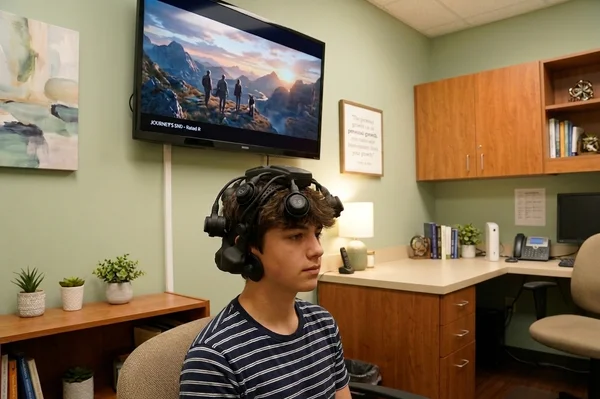
How Neurofeedback Helps Anxiety and Depression
Discover how QEEG brain mapping and BCIA-certified neurofeedback retrain brain patterns for lasting relief from anxiety and depression in Edmond, OK.