
What a QEEG Brain Map Actually Shows (And What It Doesn't)
A QEEG brain map shows how your brain's electrical activity compares to a database of people your age. It points to patterns, such as too much slow-wave activity in one area or too little coordination between two regions. It does not diagnose ADHD, anxiety, or depression, and it can't tell me what you are thinking. If you are looking into a QEEG brain map in Edmond, this is what I tell every client before we start: the map is a guide for training, and I treat it that way.
What Is a QEEG Brain Map?
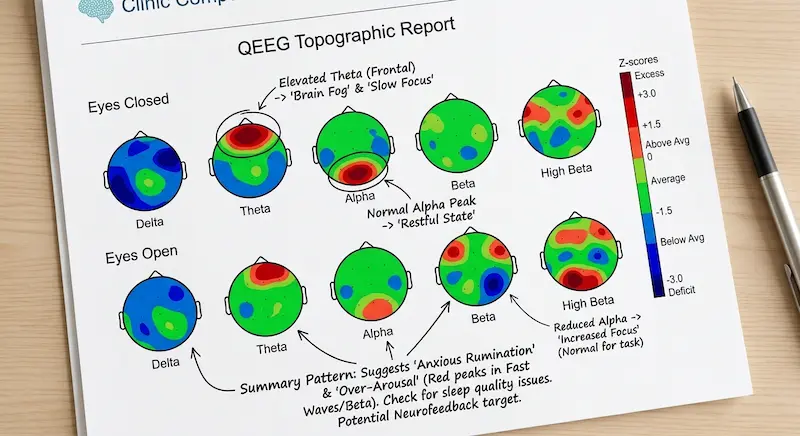
QEEG stands for quantitative electroencephalogram. A regular EEG records the electrical activity your brain produces, and a doctor reads the squiggly lines for signs of something like a seizure disorder. A QEEG takes that same recording and runs it through software. The software breaks the signal into brainwave frequencies, measures how much of each one shows up at each spot on your scalp, and compares the numbers to a normative database of people your age.
The result is the brain map. It is a set of color-coded images of your scalp, and the colors run from cool to hot. Dark blue marks areas that run well below the norm, light blue sits a little below, white falls near average, yellow runs a little above, and red marks areas that run well above the norm.
I use the map in my neurofeedback work at England Therapy. I am BCIA certified, and I have been practicing neurofeedback for four years. Before every training plan, I want to see what your brain is doing.
What Happens During a QEEG Brain Map in My Edmond Office
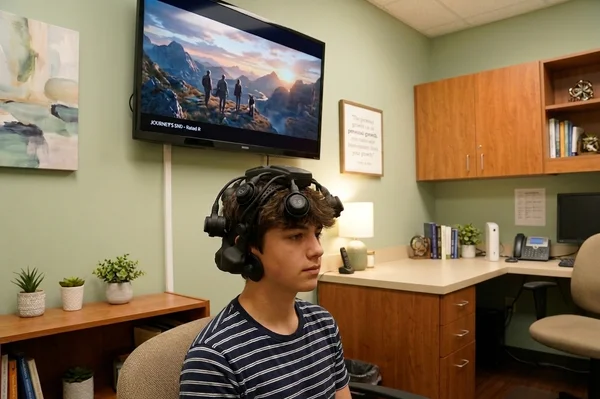
The recording itself is simple and painless. You sit in a chair while I place a soft cap on your head with small sensors. My Freedom 10 system uses 10 of them, positioned in a standard pattern across the scalp. A little gel helps the sensors pick up the signal. The sensors only listen. Nothing goes into your brain.
You then spend several minutes with your eyes closed and several minutes with your eyes open, and sometimes you do a short task such as reading. I want to see your brain at rest and under a small load. The whole appointment runs a bit longer than a standard session because of the cap setup, and the recording itself takes a fraction of that time.
My office is close to Sequoyah Middle School, Edmond North High School, and UCO, so many of my teen and young adult clients come in right after school or class.
How to Prepare for Your QEEG Brain Map
A little preparation gives me a cleaner recording:
- Limit caffeine and nicotine before your appointment, along with anything else that might alter your brain's function
- Show up rested, since a sleep-deprived brain looks different on the map
- Arrive with clean, dry hair free of heavy products so the sensors make good contact
You do not need to stop taking your medications for neurofeedback to work. Keep taking them as prescribed, and tell me what you take so I can read your map in context.
What a QEEG Brain Map Shows
A good map gives me four kinds of information.
1. How much of each brainwave you produce
Your brain produces delta, theta, alpha, and beta waves, and each one tends to run at a different speed and show up in different mental states. Slower waves usually dominate during drowsiness and relaxation. Faster waves show up during focused thinking, and very fast waves often appear during tension and worry. The map shows me whether you produce a lot more or a lot less of any wave than people your age, and in which part of the head.
2. Where the pattern sits
Location matters. A surplus of slow waves in the front of the head tells me something different from the same surplus at the back. The front of the brain handles planning, attention, and impulse control. Seeing a pattern in a particular area helps me choose where to place training sensors and what to reward.
3. How well regions talk to each other
Brain areas work as networks, and the map measures how closely two areas stay in sync. Some clients have a strong signal in each area but weak coordination between them. That finding changes how I design training.
4. Whether the two sides of the brain match
I also look at balance between the left and right sides. A marked difference between sides sometimes lines up with mood and emotional patterns, and I note it for the training plan.
What a QEEG Brain Map Doesn't Show
This section matters more than the last one. People hear "brain map" and picture a scan that reveals a diagnosis. The tool does not work that way.
It does not diagnose
No QEEG pattern, by itself, confirms ADHD, anxiety, depression, or any other condition. Diagnosis comes from a clinical interview, history, symptom checklists, and information from parents, teachers, and your physician. The FDA has cleared one EEG-based device as an aid in ADHD assessment for children and teens, but the agency described it as one piece of a larger evaluation (U.S. Food and Drug Administration, 2013). The map adds information. It does not replace the evaluation.
It does not read your thoughts or your character
The sensors pick up electrical rhythms, and they say nothing about what you think, what you have been through, or who you are. A map can't tell me whether you are a good student, a good husband, or a stubborn teenager.
It does not show structure or disease
An MRI shows the physical structure of the brain. A QEEG shows activity. If I see something in a recording that looks unusual enough to raise a medical concern, I refer you to your physician or a neurologist. I do not try to interpret it past my training.
It measures the surface
The sensors sit on the scalp, so they read activity from the outer layer of the brain. Deeper structures, such as the ones involved in fear and memory, show up only indirectly through their influence on the cortex.
It captures one day
Your brain on a given afternoon reflects sleep, caffeine, stress, medication, and mood. A map is a snapshot, and I treat it as one. That is one reason I look at the map alongside what you tell me about daily life, and why I track how you respond as training moves forward.
It does not predict a result
A map can suggest where training may help. It can't promise an outcome. Neurofeedback response varies from person to person, and I tell clients that up front.
How I Use Your QEEG Brain Map in Training
Neurofeedback is a form of brain training. You watch a video or listen to music while the software tracks your brainwaves, and the screen responds when your brain moves toward the pattern we have chosen. Over many sessions, the brain learns to produce that pattern more often. The QEEG brain map tells me which patterns to target and where to place the sensors, which keeps your training plan built around your brain and not a generic protocol.
The map also gives us a before and after. Many clients repeat the recording after a set number of sessions so we can see whether the pattern has shifted, and we compare that to how you feel and function day to day. If you are curious about how this plays out for focus, my post on neurofeedback for college student focus walks through it, and my guide on teen depression support covers how I combine brain training with talk therapy.
I often pair neurofeedback with cognitive behavioral therapy (CBT). The map shows me how your brain is running, and CBT builds the skills for the thinking and behavior patterns you want to change. Some clients do neurofeedback alone, and some do both. We decide together based on your goals.
Who Gets a QEEG Brain Map at England Therapy?
I see teens, young adults, men, and couples, and the map has been useful for a range of people in those groups:
- Teens and college students who struggle to focus, finish work, or settle their minds at night
- Men who feel stuck in anxiety, irritability, or low mood and have not found enough relief from talk alone
- Parents who want a clearer picture of what is happening with their teen before choosing a treatment path
- Clients who have tried medication or therapy and want another way to approach the problem
I offer sessions in person and online, though the QEEG recording itself takes place in my Edmond office. Some at-home training options exist after we have the map and a plan, and we can talk through those when you come in.
Questions to Ask Any Provider Before Getting a QEEG Brain Map
The quality of a map depends on the person collecting and reading it. Before you book anywhere, ask these:
- What training and certification do you have in neurofeedback and QEEG interpretation? (I hold BCIA certification, and you can verify any provider's status through the Biofeedback Certification International Alliance.)
- Does the recording include artifact checking, so muscle tension and eye blinks don't distort the data?
- How will you use the map in my treatment plan?
- Will you tell me what the map can't show?
A provider who promises that a brain map will pinpoint your problem should raise questions. A provider who explains the limits is the one to trust.
Quick Takeaways
- A QEEG brain map compares your brainwave activity to a database of people your age and shows where your patterns run high, low, or out of sync.
- The recording is painless and takes place in one visit using a cap with sensors that only listen.
- The map does not diagnose ADHD, anxiety, or depression. Diagnosis comes from a full clinical evaluation.
- The map reads the outer layer of the brain on one day, so I interpret it alongside your history and how you are doing now.
- I use the map to choose where to place sensors and what to train in neurofeedback, and I can repeat it later to track change.
- Limit caffeine and nicotine before your visit, and keep taking your medications, because neurofeedback works without stopping them.
- Ask any provider about certification, artifact checking, and the limits of the map before you book.
The Bottom Line on a QEEG Brain Map in Edmond
A QEEG brain map gives me a detailed look at how your brain is running. It helps me build a training plan around your patterns, and it gives us a way to measure change. It does not hand me a diagnosis, and it does not replace a conversation about what you are living with. I use it the way a carpenter uses a level. It tells me what to adjust, and the work still takes time and effort from you. If you are weighing a QEEG brain map in Edmond for yourself or your teen, I am glad to talk through whether it fits.
Curious whether a QEEG brain map makes sense for you or your teen? Book a free 15-minute call with England Therapy in Edmond to ask questions.
Frequently Asked Questions
No. You wear a soft cap with sensors that record your brain's natural electrical activity. The sensors do not send anything into your head. Most people describe it as sitting still with a snug hat on.
The appointment runs a bit longer than a regular session because of the cap setup. The recording itself takes a portion of that time, with eyes-closed and eyes-open segments. I go over the results with you at a follow-up visit.
No. The map shows patterns that may relate to attention, mood, or anxiety, but a diagnosis requires a full clinical evaluation. I use the map to guide neurofeedback training, and I refer you to a physician when a medical question comes up.
No. An MRI or CT scan shows the physical structure of the brain. A QEEG measures electrical activity at the scalp. They answer different questions.
I recommend one for most clients because it lets me design training around your brain. It also gives us a baseline to compare against later.
Yes. Many medications, along with caffeine, nicotine, sleep loss, and stress, affect brainwave patterns. You do not need to stop your medications for neurofeedback to work. Keep taking them as prescribed and tell me what you take so I can read the map in context. Talk to your prescriber before you change any prescription.
The recording requires the cap and equipment, so it takes place in my Edmond office. Follow-up sessions and talk therapy can happen in person or online.
What a QEEG Brain Map Actually Shows (and What it Doesn’t)
A QEEG brain map in Edmond, OK shows how your brainwaves compare to others your age. Learn what it reveals, what it can’t, and how to prepare.

Why Men Wait Nearly a Decade to Start Therapy
Men in Edmond, OK often wait nearly a decade to start therapy—trying to handle stress, irritability, and burnout alone. Learn why putting off care costs your marriage and health, and how practical, couch-free CBT therapy helps.

Teen Therapy Edmond OK: Your Teen’s First 3 Sessions
This post walks Edmond parents through the first three sessions of teen therapy with me. Session one sets goals with parents and teen, session two starts CBT with awareness, and session three moves into behavior change, with confidentiality and at-home support covered along the way.