
Teen Therapy Edmond OK: Your Teen’s First 3 Sessions
If your teenager has agreed to counseling, or you’re still working up to the conversation, you probably have one question underneath all the others: what happens in that room? Parents searching for teen therapy in Edmond OK want to know whether their kid will get grilled, whether they’ll get shut out, and whether anything will change. I’ve worked with teenagers for about two decades, and I run a solo practice in Edmond, close to Sequoyah Middle School, Edmond North High School, and UCO. This article walks you through the first three sessions with me. I shape every start around the teen in front of me, so treat this as a common path that I adjust for each family. You’ll read what happens before session one, what each of the first three visits covers, what the ongoing work looks like, how confidentiality works, and how you can support your teen from home without hovering.

Before the First Session: What Helps Most
Set the Tone at Home
Teenagers push back hardest when counseling sounds like a verdict. If you say, “We’re sending you to therapy because something is wrong with you,” you’ll get a slammed door.
Try something closer to the truth: “You’ve seemed worn down lately. I’d like you to try one session, like an experiment, and then you get a say in what happens next.” Then keep your word. A teen who feels trapped will sit in my office with crossed arms for weeks. A teen who got a genuine choice usually gives me a fair shot.
Tell your teen who they’ll meet. A little information takes the edge off. Teens in Edmond juggle school, sports, jobs, and friends, so say plainly that this hour belongs to them and nobody grades it.
Jot down what you’ve noticed before the visit: changes in sleep, grades, friendships, appetite, or temper, with rough dates. Bring the list to me privately, and skip reading it aloud in front of your teen.
Handle the Paperwork and the Questions
Oklahoma law requires written consent from a parent or legal guardian before a minor’s mental health therapy begins (Oklahoma Statutes, Title 25, §25-2005), so I ask for signed forms before we start.
Use your first contact with me to ask your own questions. The National Institute of Mental Health (NIMH) suggests asking any prospective provider whether the approach has research behind it, how parents take part, whether there is homework between sessions, how progress gets measured, and how long treatment should last. Ask me all of it. Because I run a solo practice, you get answers from me and not from a front desk.
I accept HealthChoice, and I offer both in-person and online sessions. I’m close to Sequoyah Middle School, Edmond North High School, and UCO, which keeps the drive short for many Edmond families. Ask me about fees or coverage when you reach out, and I’ll walk you through how it works.
Session One: Together, Then Apart, Then Goals
Three Parts in One Visit
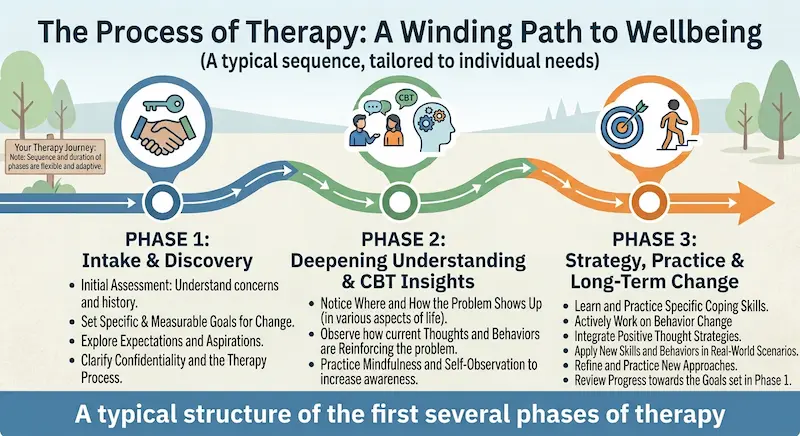
The first session runs about 50 minutes and has three parts. I start with you and your teen together. I explain who I am, what therapy looks like, and how confidentiality works, and I ask what brought you in. Next I meet with you alone. This is the time to share history, raise concerns you’d rather not say in front of your teen, and tell me how much contact you’d like with me. Then I meet with your teen alone.
Most of that last part is conversation. I ask what’s going on, what a normal week looks like, and what they’d like to change. Some teens talk freely. Others give me one-word answers, which tells me little about how therapy will go. I’ll ask about music, games, or a class they like, anything that lets them be a person and not a problem. The American Academy of Child and Adolescent Psychiatry (AACAP) describes psychotherapy as communication-based work that helps young people with their emotions and behavior. Session one is that, in its simplest form.
Some families prefer another setup, such as a parent staying for the whole session or a teen starting alone. I stay flexible. Tell me what would work for your family, and we’ll arrange it.
Goals Start on Day One
Before your teen leaves, I ask for one or two goals in their own words: “Fall asleep before midnight.” “Walk into first period without my stomach in knots.” “Stop blowing up at my brother.” A goal that belongs to a parent tends to stay the parent’s, so I want your teen’s version. You name your goals too, and we look at where the two lists overlap.
We also agree on how we’ll know it’s working. NIMH encourages parents to ask how progress will be evaluated, and I answer that question in the first visit.
Confidentiality, in Plain Language
I explain confidentiality out loud during the together portion, so you both hear the same thing. What your teen tells me stays private. I share themes and ways you can help at home, and I skip the play-by-play of what was said.
When Safety Comes First
Limits exist. If I believe your teen is at serious risk of harming themselves or someone else, or that someone is abusing them, I have to act, and I tell your teen before I do whenever I can. If an emergency comes up between sessions, call 911, or call or text the 988 Suicide & Crisis Lifeline at 988.
Where Parents Fit
Some families want regular updates. Others do better with a lighter touch, especially with older teens. We decide together in that first parent-only block, and the plan can change as therapy goes. No standard arrangement exists, because no standard family exists. For more on this stage, read my post on what to expect in your teen’s therapy session.
Session Two: Building Awareness with CBT
The Three Questions Every Teen Asks Quietly
By the second visit, most teens run a private test. They rarely say it out loud, but they wonder: Is what I say safe here? Will this person take me seriously or lecture me? Am I here because I’m the problem?
I answer those through my behavior. I keep my promises about privacy. I listen before I give an opinion. I ask what they think is going on before I say what I think. Parents sometimes expect visible progress at this point. From the outside it can look like nothing happened, yet the trust built here makes everything after it possible. At the end, I ask your teen what, if anything, they want me to share with you. That small piece of control loosens up a lot of teens.
Starting CBT: Awareness First
In session two I start cognitive behavioral therapy, or CBT. AACAP explains that CBT aims to improve mood, anxiety, and behavior by examining distorted patterns of thinking. We look at the current pattern: what happens, what your teen tells themselves about it, how they feel, and what they do next. I want them to be aware of what’s happening to them and how their issue is showing up in their life. Awareness is always step 1.
Picture a teen who does poorly on one quiz. They think, “I’m just not smart.” Dread follows, so they skip the study session and dodge the class. The quiz did not cause the avoidance. The thought did much of the work. Most teens have never seen that chain laid out, and seeing it gives them something to work with. I explain it in plain language, because teens notice when an adult talks down to them.
I also map the wider picture: mornings, sleep, the hour before school, friendships, and when the worry or irritability spikes and eases. The same surface problem, such as slipping grades, can come from performance anxiety, a tired body, trouble with a friend, or a mood that has sat low for months. I don’t guess. A plan built on a guess fits a generic teenager, and yours is a specific person. My guides on teen depression and choosing a teen therapist in Edmond add context.
Session Three: From Noticing to Changing
Practicing a New Response
In session three, we start working on behavior change. Instead of just noticing, we now work on positive behaviors and thoughts to bring about change in your teen’s life.
Return to the quiz example. Your teen tests the thought “I’m just not smart” against evidence, such as last month’s grade, and swaps in a more accurate one: “I missed a few concepts, and I can learn them.” Then they act on it. They attend the study session for twenty minutes and show up to class. Thought and behavior shift together, and each one supports the other.
Between sessions, I ask for small experiments: catch a thought and rewrite it, change an evening routine, start a conversation they’ve been avoiding. Each experiment ties back to the goals your teen set in session one.
A Fit Check
Around this visit I ask your teen directly: Is this working for you? Do you feel heard? I ask you, too. NIMH points out that rapport and trust are essential in therapy, and its guidance on what to look for in a therapist is worth reading. If something feels off, I want to hear about it early so I can adjust.
After Session Three: Working Hard on the Goals
What Ongoing Sessions Look Like
Each session, we review the week, look at what got in the way, and pick what to practice next. I tell teens that therapy doesn’t happen to them. It works when they put in effort, so I expect them to work hard on their goals, and I work hard beside them. That expectation shows respect, and after two decades with teens I’ve watched them rise to it.
Progress arrives in small, practical form first: a calmer morning, a shorter argument, a full week of school attended. Pace differs for each teen, and I adjust as we go. Online sessions help when schedules get tight, so ask me about them.
Supporting Your Teen Between Sessions
Skip “How was it?” on the drive home. Ask, “Is there anything I can do this week?” and accept a shrug. Keep sleep, meals, and evenings predictable. Point out effort: “I saw you stick with that” lands better than “Did you do your therapy homework?”
Bring your own concerns to me by phone or email, and keep them out of earshot of your teen. If you can’t tell how to respond to something, ask me. I’d rather you check in than guess.

Quick Takeaways
- Session one has three parts: you and your teen together, then you alone, then your teen alone. I adjust the setup for your family.
- Goals get set in the first session, in your teen’s own words.
- Session two starts CBT with awareness, so your teen sees how the issue shows up in daily life.
- Session three moves to behavior change, with new thoughts and actions practiced between visits.
- Ongoing work takes effort from your teen, from me, and from you.
- Steady routines and low-pressure questions are your best support at home.
- Every stage is personalized to your teen’s age, temperament, and situation.
Conclusion
The first three sessions follow a simple path. In session one, we meet together, then you and I talk alone, then I meet your teen, and we leave with goals in your teen’s words. In session two, we start CBT and build awareness of how the problem shows up in daily life. In session three, we begin changing behavior and thinking. After that, the work gets active, and it takes effort from your teen, from me, and from you.
I adjust all of it. Two decades with teenagers has taught me that no two arrive the same way, so the order, the pace, and the parent role shift with your teen’s age, temperament, and what’s happening at home and at school. If your family wants a different setup for the first visit, I’m glad to arrange it.
If you’re weighing teen therapy in Edmond OK, the next step is small. Visit englandtherapy.com, send a message, and ask about scheduling, in-person or online sessions, HealthChoice, or fees. I’d rather answer your questions before you commit. Then ask your teen to try one session, like an experiment, and see what happens.
Frequently Asked Questions
What question did you most want answered before your teen’s first session? Leave it in the comments, and I’ll cover it in a future post. If this guide helped, share it with another parent who’s wondering what teen therapy looks like.
References
- American Academy of Child and Adolescent Psychiatry. Psychotherapies for Children and Adolescents.
- American Academy of Child and Adolescent Psychiatry. Psychotherapy for Children and Adolescents: Definition.
- National Institute of Mental Health. Psychotherapies.
- National Institute of Mental Health. Children and Mental Health: Is This Just a Stage?
- Oklahoma Statutes, Title 25, §25-2005. Written consent required for mental health treatment of minors.
- 988 Suicide & Crisis Lifeline. 988lifeline.org.