
Beyond Talk Therapy: Understanding Counseling vs. Neurofeedback (Part 1)
When your teenager is struggling with anxiety, depression, ADHD, or emotional regulation challenges, you naturally want to explore every possible avenue for support. While traditional counseling has helped countless families, it's not always the complete answer—and that's perfectly okay. As a practitioner trained in both counseling and neurofeedback, I work with parents every day who are seeking mental health treatment that isn't counseling, or who want to complement their teen's existing therapy with something that addresses the brain more directly.
In my practice, I've witnessed remarkable transformations when families discover neurofeedback. This brain-based approach offers a fundamentally different pathway to mental wellness, one that doesn't rely on talking through problems or processing emotions verbally. Instead, it works directly with your teen's brain patterns to create lasting change from the inside out.
I am trained in counseling and neurofeedback. In my practice, I treat anxiety, depression and ADHD with both methods. I can do both in my office in Edmond or online in Oklahoma. So, I don't have a preference until we meet and talk about your goals. Then, I can make a recommendation if you're not sure which one you want to use.
If you've been wondering whether there are effective alternatives or additions to traditional counseling, you're in the right place. This two-part series explores how neurofeedback differs from counseling and why it might be the missing piece in your teenager's mental health journey.
Understanding the Two Approaches: How They Work
What Is Traditional Counseling?
Traditional counseling involves meeting with a licensed therapist who helps individuals explore their thoughts, feelings, and behaviors through conversation. The therapist provides a safe space for your teenager to discuss challenges, process emotions, and develop coping strategies. According to the American Psychological Association, counseling focuses on identifying negative thought patterns, processing difficult experiences, developing communication skills, and creating behavioral changes through insight and understanding.
Different therapeutic modalities exist, including cognitive-behavioral therapy (CBT), dialectical behavior therapy, and psychodynamic therapy, each with its own approach to helping teens navigate mental health challenges.
What Is Neurofeedback?
Neurofeedback is a non-invasive, brain-training approach that helps individuals regulate their brain activity. During sessions, sensors placed on your teen's scalp monitor brainwave patterns in real-time, providing immediate feedback through visual or auditory cues. When the brain produces desirable patterns, it receives positive reinforcement. When patterns drift, the feedback changes, guiding the brain back to healthier functioning.
Over time, the brain learns to self-regulate more effectively, addressing dysregulated brainwave patterns, neurological functioning, attention, focus, and emotional stability at their source. The International Society for Neuroregulation & Research recognizes neurofeedback as an evidence-based intervention for various neurological and psychological conditions.

The Fundamental Difference: Where Change Happens
The most significant distinction between counseling and neurofeedback lies in where each approach creates change.
Counseling: Top-Down Processing
Counseling works from the "top down," meaning it engages the conscious mind to create change. Your teenager actively participates by talking, reflecting, and implementing strategies discussed in sessions. This requires verbal communication skills, self-awareness, and the ability to translate insights into behavioral changes.
For many teens, this approach is incredibly valuable. They develop self-understanding, learn to articulate their feelings, and gain tools for managing challenges. However, some adolescents struggle with this format—they may find it difficult to open up, resist traditional talk therapy, or simply not respond as hoped despite genuine effort.
Research published in the Journal of Child Psychology and Psychiatry shows that while talk therapy can be highly effective, approximately 40% of adolescents don't respond adequately to traditional therapeutic approaches alone, suggesting the need for complementary interventions.
Neurofeedback: Bottom-Up Regulation
Neurofeedback operates from the "bottom up," working directly with the brain's electrical activity. Rather than requiring your teen to talk about their problems or consciously change their thinking, neurofeedback teaches the brain itself to function more efficiently.
This is particularly powerful because many mental health challenges in teenagers stem from dysregulated brainwave patterns—neurological imbalances that existed before symptoms emerged. When a teen's brain is producing excessive slow waves in areas responsible for attention, or overactive fast waves in regions governing anxiety, no amount of talking will directly correct those patterns. Neurofeedback can.
According to research in Clinical EEG and Neuroscience, neurofeedback training can produce measurable changes in brain function that correlate with symptom improvement, particularly for conditions like ADHD, anxiety, and sleep disorders.
When Each Approach Shines: Different Tools for Different Needs
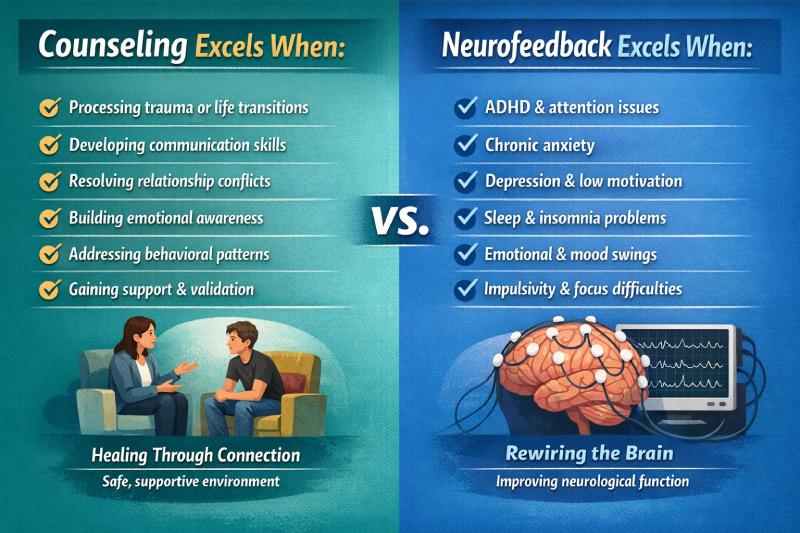
Counseling Excels When:
Traditional counseling is particularly effective when your teenager needs to:
- Process specific traumatic events or difficult life transitions
- Develop interpersonal communication skills
- Work through relationship conflicts with family or peers
- Build emotional vocabulary and self-awareness
- Address behavioral patterns rooted in learned responses
- Benefit from the therapeutic relationship and human connection
Many teens find tremendous value in having a trusted adult to confide in, someone outside the family who can offer perspective and support. The counseling relationship itself becomes a healing factor, providing validation and understanding during tumultuous years.
The National Alliance on Mental Illness (NAMI) emphasizes that the therapeutic relationship is often as important as the specific techniques used, particularly for adolescents who need a safe space to explore their identity and challenges.
Neurofeedback Excels When:
Neurofeedback is especially powerful for challenges that have a strong neurological component:
- ADHD and attention difficulties that interfere with school performance
- Anxiety that seems to come from nowhere or persists despite talk therapy
- Depression characterized by low energy and lack of motivation
- Sleep disturbances and insomnia
- Emotional dysregulation and intense mood swings
- Impulsivity and difficulty with self-control
- Processing challenges and cognitive difficulties
- Symptoms that haven't responded fully to counseling alone
I often see teenagers who have been in counseling for months or even years with only modest improvements. They're doing the work—showing up, trying the strategies, being open and honest—but something fundamental isn't shifting. That's frequently because the underlying brain patterns driving their symptoms haven't changed.
Studies published in Applied Psychophysiology and Biofeedback demonstrate that neurofeedback can be particularly effective for adolescents with ADHD, anxiety disorders, and emotional regulation difficulties, with improvements often maintained long-term.
Addressing Root Causes vs. Symptoms
Counseling typically focuses on psychological, emotional, and behavioral dimensions—identifying triggers, understanding emotional roots, developing healthier responses, and processing past experiences. This is crucial work, as many mental health challenges have significant psychological components that benefit from counseling's approach.
Neurofeedback targets the neurological underpinnings of symptoms—brainwave dysregulation present before symptoms emerged, inefficient brain patterns making regulation difficult, and neurological factors that medication typically targets. Many teenagers I work with have underlying brain patterns that predispose them to anxiety, attention difficulties, or mood instability. While counseling helps teens manage these challenges more effectively, neurofeedback can actually alter the brain patterns themselves.
The Role of Verbal Processing
Traditional therapy centers on verbal expression—putting feelings into words, describing experiences, and articulating thought patterns. For many teens, this is valuable for self-understanding and communication. However, not everyone is wired for verbal processing. Some teenagers are more action-oriented or simply struggle to identify and express emotions.
Neurofeedback requires no verbal processing whatsoever. The brain learns and changes through direct feedback, not through talking. This can be liberating for teens who feel pressure to have insights or explain feelings. Interestingly, many families find that neurofeedback actually enhances their teen's ability to benefit from counseling when used together, as brain patterns regulate and symptoms ease.
The Question of Active Participation
Counseling Requires Engagement
For counseling to be effective, your teenager must be willing to attend and participate, have sufficient verbal and emotional awareness, practice skills between sessions, be honest and open, and complete therapeutic exercises. When a teen is resistant, unmotivated, or exhausted by symptoms, engaging fully becomes difficult.
Neurofeedback Works Without Conscious Effort
With neurofeedback, your teen doesn't need to talk about problems, process difficult emotions, practice specific skills, complete homework, or even believe it will work. The training happens at a neurological level, below conscious awareness. As long as your teenager can sit relatively still for 30-45 minutes while watching a favorite show, their brain will receive and respond to the training. This makes neurofeedback accessible even for resistant teens or those worn out from trying everything else.
Can You Do Both? The Complementary Approach
You don't have to choose between counseling and neurofeedback—many families find combining both yields the best results. Neurofeedback creates neurological stability that makes counseling more effective, while counseling provides emotional processing and skill development that supports lasting change. Together, they address both brain-based and psychological aspects of challenges.
I frequently see teenagers stuck in counseling make rapid progress once we add neurofeedback. As brain patterns regulate, they become more emotionally available and responsive to the counseling process. Conversely, teens doing neurofeedback alone sometimes benefit from adding counseling to process emotions that surface or work through interpersonal challenges that neurofeedback alone can't address.
In my practice, I often recommend neurofeedback as the foundation, especially when symptoms have strong neurological components or previous counseling hasn't produced sufficient change. Once brain patterns begin stabilizing, adding counseling can help your teenager build on that foundation with skill development and relationship work.
Research from the Association for Applied Psychophysiology and Biofeedback supports integrative approaches, showing that combining neurofeedback with traditional therapy often produces superior outcomes compared to either intervention alone.
Making the Right Choice for Your Teen
Consider Neurofeedback If:
Your teenager might benefit particularly from neurofeedback if they have ADHD, anxiety, or attention challenges; previous counseling helped somewhat but not enough; they're resistant to traditional talk therapy; you're looking for mental health treatment that isn't counseling; they struggle with emotional regulation; sleep problems or cognitive difficulties are prominent; or you want a medication-free or complementary approach.
Consider Counseling If:
Traditional counseling may be most beneficial if your teen has specific traumatic experiences to process, needs relationship skills development, is dealing with grief or life transitions, responds well to verbal processing, or has behavioral patterns needing conscious examination.
Consider Both If:
An