
When the Joke Isn't Funny Anymore: A Parent's Guide to the Class Clown
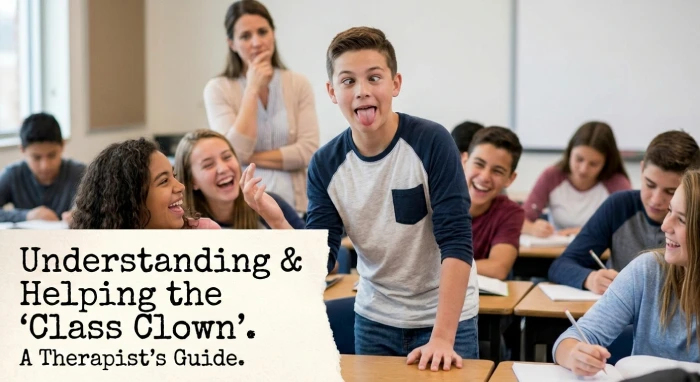
Every parent knows the moment. Your kid's teacher pulls you aside after school — or maybe it's a note sent home, or a call during your lunch break — and says some version of: "Your child is disrupting the class again." You go home and ask your teen about it, and they shrug it off with a joke. You laugh a little. They laugh a little. And somehow the conversation never really happens.
If your child has earned the unofficial title of "class clown," you've probably cycled through pride, frustration, confusion, and worry — sometimes all in the same afternoon. Funny kids are fun. They're magnetic. They make people feel good. But when the jokes never stop, when every serious moment gets deflected with a punchline, and when teachers are calling regularly, it's worth asking a harder question: what is the humor actually doing?
For many adolescents, humor isn't just a personality trait. It's armor. Social anxiety and humor in adolescents often go hand in hand in ways that parents don't always recognize. This guide is here to help you see past the punchline — and figure out how to really support your kid.
As someone who grew up in Edmond, I know the pressures teens may have to fit in.
Understanding Why Teens Become the Class Clown
Before you can help your teen, it's important to understand what's actually driving the behavior. The "class clown" label sounds harmless, almost endearing, but the roots of that role are often more complex than they appear.
Research published in Frontiers in Psychology found that class clown behavior has both social benefits and real downsides. Kids who show genuine comic talent do tend to have more friends and are better accepted by peers. But the same study found that class clown behavior is also associated with more disruptive and even aggressive behavior in the classroom. It's a complicated picture — humor opens doors socially, but it can also become a wall.
So why does a kid become the class clown in the first place? There are usually a few things going on:
Peer acceptance and fear of rejection. Adolescence is a time when being liked by peers feels like survival. Making people laugh is one of the fastest ways to earn social currency. If a teenager isn't sure they're likeable on their own terms, humor becomes a shortcut — a guaranteed way to get a positive reaction.
Covering for academic struggles. Some kids who struggle with reading, focus, or understanding are far more comfortable looking intentionally silly than accidentally confused. The joke is something they choose; the failure is not. Disruption becomes a form of control.
Anxiety and stress from home. A number of researchers and clinicians note that kids who grow up in high-stress or chaotic home environments sometimes adopt humor as a default coping mechanism. They learn early that lightening the mood keeps things from escalating.
ADHD and neurodivergence. There's a well-documented connection between ADHD and class clown behavior. Kids with ADHD are often genuinely quick-witted and theatrical, and their impulsivity makes it harder to hold back a funny thought even when the timing is terrible.
The sad clown phenomenon. Psychologists use this phrase to describe what happens when humor masks inner pain. Kids who are quietly struggling with depression, anxiety, or low self-worth sometimes develop outsized public personas — always on, always performing — as a way of managing those internal feelings from a distance.
Social Anxiety and Humor in Adolescents: The Hidden Connection
Here's something that might surprise you: the class clown in your kid's school may be one of the most socially anxious people in the room.
That seems counterintuitive. Socially anxious kids are supposed to be shy, quiet, withdrawn — right? Not always. Social anxiety disorder is characterized by an intense, persistent fear of being judged or humiliated in social situations. One way to manage that fear is to control the narrative. If you're already making people laugh, you're already controlling how they see you. You get to decide what the joke is before someone else does.
This is sometimes called self-defeating humor — using jokes at your own expense to get ahead of potential judgment. Research from the PMC National Library of Medicine describes self-defeating humor as excessive self-disparagement often used to ingratiate oneself or gain acceptance from others, and notes that it can reflect underlying neediness or lack of self-confidence. In adolescents, this type of humor has been linked to higher anxiety, lower self-esteem, and reduced overall well-being.
The catch is that self-defeating humor works in the short term. People laugh. The kid feels accepted. The anxiety is temporarily quieted. So they do it again, and again, until it becomes the only tool they know how to use.
According to research published in the PMC, approximately 12% of adolescents meet clinical criteria for social anxiety disorder, making it one of the most common mental health conditions in this age group — and one of the most underdiagnosed, precisely because many teens have found ways to hide it.
My office is in walking distance from Sequoyah Middle School and Edmond North High School.
Warning Signs: When Humor Becomes a Red Flag

So how do you know when your child's humor has crossed from healthy self-expression into something that needs attention? The difference isn't always obvious, but there are patterns to look for.
The humor never turns off. Every serious conversation gets deflected with a joke. Attempts to talk about school, friendships, or how they're feeling are met with humor that effectively ends the conversation. This is called emotional avoidance, and it's a significant sign that something harder is being managed underneath.
They seem to need the laughs. Pay attention to how your kid responds when something isn't funny — when a joke lands flat, or when they're in a setting where the humor doesn't work. Do they get anxious? Withdraw? Keep pushing until they get a reaction? That need for the laughs to keep coming can indicate that those laughs are doing emotional heavy lifting.
Humor that punches down. There's a difference between a kid who has a sharp, observational wit and a kid whose humor frequently targets others — classmates, teachers, or even family members. When humor becomes a way of establishing social dominance or deflecting vulnerability by putting someone else in the spotlight, that's a sign of deeper insecurity.
Teachers are frustrated, but nothing changes. Most teens can modulate their behavior when they understand the consequences. If your child keeps disrupting class despite knowing the impact, and despite genuinely trying to stop, that compulsive quality suggests the behavior is serving a psychological need that simple discipline isn't going to fix.
Humor as the only emotional register. If you can't remember the last time your kid talked to you about something that genuinely mattered — a fear, a disappointment, a hope — and every interaction is filtered through performance, that flatness is worth paying attention to. Masking emotional distress behind humor is increasingly recognized as a form of depression presentation in adolescents.
I'm a proud graduate of Edmond schools.
What the Research Actually Tells Us About Humor and Teen Development
Let's take a step back and acknowledge something important: humor itself isn't the problem. In fact, a healthy sense of humor is genuinely protective. Studies have found that adolescents who use humor effectively tend to have better peer relationships, stronger social skills, and even lower rates of depression.
The key word is how humor is being used.
Researchers have identified distinct humor styles, and they don't all function the same way. Affiliative humor — jokes that bring people together, defuse tension, and make everyone feel included — is associated with strong social functioning and well-being. Self-enhancing humor — the ability to find something funny even when things are hard — functions as a genuine coping tool.
The styles that cause concern are aggressive humor (using jokes to put others down or dominate) and self-defeating humor (making yourself the butt of the joke to gain acceptance). Both of these styles have been linked to anxiety, lower self-esteem, and diminished relationship quality in adolescent research.
The good news: humor styles aren't fixed personality traits. They're learned patterns, and they can be redirected with the right support and environment. A kid who has learned to use humor defensively can learn to use it in healthier ways — but that process usually requires understanding why the defensive pattern developed in the first place.
How to Talk to Your Teen About This (Without Killing the Vibe)

If you've recognized some of these patterns in your child, the next question is: how do you bring it up without making things worse?
The biggest mistake parents make is treating class clown behavior as purely a discipline issue and responding with frustration or ultimatums. The second biggest mistake is going the other direction — ignoring it, or assuming it's "just a phase." Both approaches leave the underlying emotional need unaddressed.
Lead with curiosity, not correction. Instead of "your teacher is frustrated with you and you need to stop," try something like "I've been thinking about how much you make people laugh — what does it feel like when everyone's cracking up?" This opens a door rather than closing one.
Find the right time. Teenagers are notoriously resistant to serious conversations when they're tired, hungry, or feel cornered. Side-by-side conversations — in the car, on a walk, doing something else together — work better than face-to-face sit-downs, which can feel like an interrogation.
Acknowledge the gift. Your kid's wit is genuinely valuable. Say so. The goal isn't to make them less funny — it's to help them have access to more of themselves than just the punchline. When teens feel like a parent "gets" something about who they are, they're much more likely to let that parent in.
Bring up what you've noticed, not what you've decided. "I've noticed that when things get serious you usually make a joke" is an observation. "You use humor to avoid your feelings" is a diagnosis. One invites a conversation; the other ends it.
Be honest about your own worry. If you're concerned about your kid, saying so directly — "I love watching you make people laugh, and I also want to make sure you're okay underneath all of that" — models the kind of emotional openness you're hoping to encourage in them.
Middle school was tough for lots of us.
The Role of School in Supporting Your Child
Parents can't do this alone, and they shouldn't have to. Teachers, school counselors, and other adults in your child's life can be important partners in this process — but only if there's communication and a shared understanding of what's actually going on.
Talk to your child's teachers not just about the behavior, but about the child behind it. Share what you know about your kid — their strengths, what they're worried about, what makes them feel seen. A teacher who understands that a kid is performing anxiety rather than just being disruptive will respond very differently than one who simply sees a problem student.
Explore whether your child's humor could be channeled constructively. Drama clubs, improv programs, speech and debate teams, and comedy writing electives are places where humor is a skill to be developed, not a disruption to be managed. When funny kids find legitimate stages, the pressure to perform in inappropriate contexts often eases.
Ask about school counseling resources. Most schools in the Edmond area have counselors who can meet with students regularly and who can provide an important bridge between what's happening at school and what support might be helpful outside it.
When to Seek Professional Support
Some of what I've described can be addressed through better communication, the right school supports, and a more informed parenting approach. But sometimes the humor is masking something that genuinely needs professional attention — and there's no shame in that. In fact, recognizing when to seek help is one of the most important things a parent can do.
Consider reaching out to a therapist if your teen's behavior isn't changing despite your best efforts and real consequences. If the jokes keep coming even when your child clearly doesn't want them to, and even when they've promised to stop, the behavior may be serving a compulsive psychological function.
Look for signs of depression alongside the humor — withdrawal from activities they used to enjoy, changes in sleep or appetite, increasing isolation from friends, or a flatness when the performance is down. Humor can coexist with significant depression — in fact, it often does.
Consider professional support when your child is being excluded or bullied despite (or because of) their humor. Social anxiety that isn't addressed tends to get worse over time, not better. Adolescence is a developmentally sensitive period for anxiety, and early intervention genuinely changes outcomes.
Finally, pay close attention during major stress or transitions. Moves, divorce, academic pressure, social changes — teens who were managing their anxiety reasonably well can struggle during periods of heightened stress, and their humor may become more frantic, more compulsive, and more disruptive.
I offer both in-person sessions at my Edmond office and online sessions for families across Oklahoma. My approach is tailored to each individual child — there's no one-size-fits-all method here. Together, we'd take time to understand your specific teen: what's driving their behavior, what they're managing underneath, and what kind of support will actually help them. The first step is usually a conversation — reach out to inquire about getting started.
Healthy Ways to Support the Funny Kid in Your Life
If you've made it this far and you're thinking "okay, but I don't want my kid to lose what makes them special," I want to reassure you: the goal is never to make a funny kid less funny. The goal is to make sure they have access to more than just the funny.
Make your home a place where it's okay to not perform. If your household dynamic runs on humor — and a lot of good families do — it's worth asking whether there's also space for the harder stuff. Can your kid be sad at the dinner table? Can they say "I'm scared about something" without it immediately getting lightened? The answer to that question tells them a lot about what's safe.
Model appropriate vulnerability. Kids learn emotional patterns from watching the adults in their lives. When you say "that was hard for me today" or "I'm worried about something," you're teaching your child that admitting difficulty is something adults do — and that it doesn't have to be funny.
Celebrate the whole kid. Make a point of noticing and naming things about your child that have nothing to do with being entertaining. Their kindness, their persistence, their creativity, their loyalty. The class clown identity can become a cage when it's the only thing a kid feels valued for.
Stay curious. The fact that you're reading this article suggests you're already doing something important — you're paying attention. Keep doing that. Trust your instincts. If something feels off, it probably is. And if your kid pushes back when you try to connect, that's not a reason to stop trying — it's usually a sign they need you to try harder.
Quick Takeaways
- Class clown behavior in adolescents is often linked to social anxiety, fear of rejection, or a need to control how others perceive them.
- Self-defeating humor is a style particularly associated with anxiety and lower self-esteem in teens. Social anxiety disorder affects up to 12% of adolescents and is frequently under-recognized because affected teens find ways to hide it — including through humor.
- The goal is not to eliminate a teen's humor but to help them develop emotional range beyond the performance.
- Effective conversations with funny teens start with curiosity and acknowledgment of their strengths, not correction alone.
- School-based outlets like drama, improv, and speech provide legitimate stages for humor to be expressed constructively.
- Professional support is worth considering when the behavior is compulsive, when depression signs appear alongside the humor, or when standard approaches aren't working.
Conclusion
Funny kids deserve to be seen for all of who they are — not just the performance they've practiced, but the person underneath it. When you start to understand that the joke might be doing something more than entertaining people, you're already asking the right questions.
The class clown doesn't need to stop being funny. They need to know that they don't have to be funny — that they are valued, accepted, and safe when the performance is down. That's a message that takes time and intentionality to deliver, but it's one of the most important things a parent can communicate.
If you're in the Edmond area and wondering whether your child could benefit from support, I'd love to talk. My practice focuses on adolescents and families navigating exactly these kinds of questions — the ones that don't have easy answers, the ones where something feels off but you're not quite sure what to do about it. I offer both in-person and online sessions, and every approach I take is specific to your child's needs and story.
Ready to take the next step for your teen?
Reach out today to start a conversation. Your kid's humor is a gift. Let's make sure they have everything else they need too.
Frequently Asked Questions
We'd Love to Hear From You
Did this article resonate with something you're experiencing with your own kid? Are you seeing the humor-as-armor pattern in your household, or does your teen's story look different? I'd love to hear your thoughts in the comments below — and if this was helpful, sharing it with another parent who might need it is one of the kindest things you can do.
What's one thing you've tried when talking to your teen about their behavior that actually worked? Drop it in the comments.
References
- Wagner, L. (2019). The Social Life of Class Clowns: Class Clown Behavior Is Associated With More Friends, but Also More Aggressive Behavior in the Classroom. Frontiers in Psychology. frontiersin.org
- Fox, C. L., et al. (2016). Children's Understanding of Self-Focused Humor Styles. PMC / National Library of Medicine. pmc.ncbi.nlm.nih.gov
- Compton, S. N., et al. (2012). Treating Adolescents with Social Anxiety Disorder in Schools. PMC / National Library of Medicine. pmc.ncbi.nlm.nih.gov
- Banner Health. (2023). How to Help a Teenager with Social Anxiety. bannerhealth.com
- Understood.org. (2023). Why Some Kids Clown Around in Class. understood.org
Raising Screenagers: How to Help Teens Connect in Real Life
If you’ve ever called your teenager for dinner only to receive a one-word answer from behind a closed door, or watched them disappear into their phone in a room full of people, you know the ‘screenager’ phenomenon. For many teens today, the digital world doesn’t just feel more fun—it feels safer.
In this article, Jerred England, LMFT, explores why teens are increasingly trading face-to-face interaction for digital safety. From the ‘tightening cycle’ of social avoidance to the neurobiology of why screens reduce social anxiety, we look at the difference between healthy digital connection and total isolation. Most importantly, we provide actionable strategies for parents to help their teens build real-world confidence, step by uncomfortable step, through evidence-based approaches like CBT and ACT.
When the Joke Isn’t Funny Anymore: A Parent’s Guide to the Class Clowns
If your child has earned the title of “class clown,” there’s a good chance the jokes are covering something deeper. Learn how to recognize the warning signs, start the right conversations, and know when it’s time to seek support.

5 Signs Your Son’s School Behavior Problems Require Professional Counseling
Is your son constantly in trouble at school — with teachers, coaches, and at home? Learn the 5 signs that go beyond normal teenage rebellion and how evidence-based CBT and ACT counseling can help teen boys in Edmond, OK turn things around before the consequences become permanent.

Is Teletherapy Right for My Teen? Balancing Convenience and Connection
As a therapist who has worked with Oklahoma teens for over 20 years, I know that the most important factor in therapy isn’t whether we meet online or in person — it’s the relationship we build together. This guide helps parents understand when teletherapy works best, when in-person sessions matter more, and how to find the right fit for their teenager.
Beyond Talk Therapy: Understanding Counseling vs. Neurofeedback (Part 2)
Discover how objective QEEG brain mapping removes the guesswork from mental health treatment by providing a personalized roadmap for your teenager’s brain. Learn why neurofeedback’s relaxing, medication-free approach is a powerful alternative for teens who are “talked out” or struggling with ADHD and anxiety.
Beyond Talk Therapy: Understanding Counseling vs. Neurofeedback (Part 1)
Traditional counseling uses “top-down” verbal processing to build coping skills and insight, while neurofeedback employs “bottom-up” brain training to regulate neurological patterns directly. Together, these approaches offer a comprehensive pathway to mental wellness by addressing both the psychological and physiological roots of challenges like ADHD, anxiety, and depression.
