
Beyond Talk Therapy: The Neurofeedback Advantage (Part 2)
Welcome back to our series on counseling versus neurofeedback for teenagers. In Part 1, we explored the fundamental differences between these two approaches and when each one excels. Now, let's dive deeper into the practical aspects of neurofeedback—how it works, what to expect, and how to get started.
Quick Reminder: I am trained in counseling and neurofeedback. In my practice, I treat anxiety, depression and ADHD with both methods. I can do both in my office in Edmond or online in Oklahoma. So, I don't have a preference until we meet and talk about your goals. Then, I can make a recommendation if you're not sure which one you want to use.
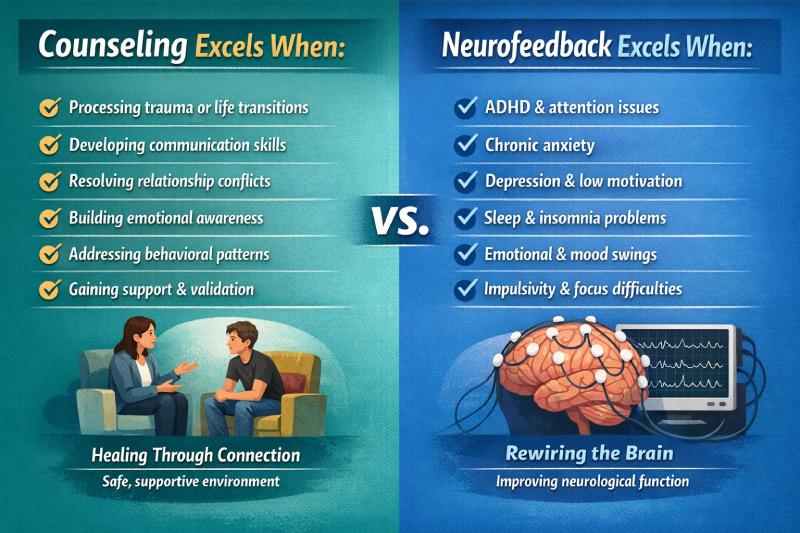
A visual comparison of counseling and neurofeedback treatment approaches
The Brain Mapping Advantage: Personalized Care
In my practice, I use QEEG (Quantitative Electroencephalogram) brain mapping to create truly personalized neurofeedback protocols. This is one of the significant differentiators in my approach to mental health treatment that isn't counseling.
What Brain Mapping Reveals
A QEEG brain map is like a diagnostic snapshot of your teenager's brain function. During this painless, non-invasive assessment, I place sensors on your teen's scalp while they sit quietly for about 20 minutes. These sensors detect the electrical activity produced by billions of neurons communicating.
The resulting brain map shows me:
- Which areas of the brain are overactive or underactive
- How different brain regions communicate with each other
- Specific brainwave imbalances correlated with symptoms
- Your teen's unique neurological patterns
Unlike counseling, which relies on subjective reports of symptoms, brain mapping provides objective data. I can literally see what's happening in your teenager's brain and target those specific patterns with precision.
The EEG and Clinical Neuroscience Society recognizes QEEG as a valuable clinical tool for assessing brain function and guiding treatment decisions, particularly for neurodevelopmental and psychiatric conditions.
Tailored Training for Individual Brains
Based on the brain map, I develop a customized training protocol designed specifically for your teen's needs. If the map shows excessive theta waves (associated with low arousal) in the frontal regions where attention is regulated, I'll train those areas to produce more appropriate patterns for focus. If there's too much high-beta activity (linked to anxiety) in emotional processing centers, I'll work on calming those regions.
This personalized approach means every teen receives training designed for their unique brain, not a one-size-fits-all protocol. While counseling can certainly be tailored to individual needs, it can't provide this level of neurological specificity. According to research published in NeuroImage: Clinical, individualized neurofeedback protocols based on QEEG data show significantly better outcomes than standardized approaches.
The Sessions: What Your Teen Experiences
A Typical Counseling Session
In counseling, your teenager engages in 45-60 minute conversations with their therapist, discussing recent events, exploring thought patterns, learning coping skills, and processing emotions. The experience requires mental presence, willingness to engage, and ability to articulate internal experiences—skills that can be challenging for some adolescents.
The therapeutic process typically involves homework assignments, practicing new skills between sessions, and actively working to change behaviors and thought patterns. This conscious engagement is both the strength and potential limitation of talk therapy.
A Typical Neurofeedback Session
Neurofeedback sessions look quite different. After an initial intake to gather an overview of symptoms, training sessions typically last 30-45 minutes. I place small sensors on your teen's scalp (painless—no electrical current enters the brain), and they sit comfortably watching a movie, playing a simple game, or listening to music.

A teenager engaged in a comfortable neurofeedback training session
The neurofeedback system monitors brainwaves continuously, providing feedback through the entertainment. When their brain produces optimal patterns, the screen brightens or music continues smoothly. When patterns drift, the feedback changes, cueing the brain to self-correct automatically. Your teenager doesn't need to talk about problems or consciously do anything—the training happens as their brain learns from the feedback.
Many parents are surprised by how relaxing neurofeedback sessions are. Teens often describe them as peaceful, even meditative. There's no pressure to perform, no difficult emotional processing, and no homework. The brain does the work naturally, learning to self-regulate just as it would learn any other skill.
Training and Retesting: The Neurofeedback Process
Unlike counseling, where progress is assessed through self-report and behavioral observations, neurofeedback offers objective measurements. I monitor your teen's brainwave patterns during sessions, tracking subtle shifts as the brain begins self-regulating. At regular intervals, I retest brain function to see how patterns are changing, allowing data-driven protocol adjustments.
Most families see improvements within 10-20 sessions, though complex situations may require additional training. The typical recommendation is 30-40 sessions for comprehensive change. Throughout this process, I train and retest as we go, ensuring your teen's protocol evolves with their progress.
In counseling, therapists track progress through verbal reports, behavioral observations, and standardized questionnaires—valuable measures, but relying heavily on subjective experience. The objective nature of neurofeedback assessment provides a complementary perspective that many families find reassuring.
The Timeline of Change
Counseling's Timeline
With traditional counseling, improvement timelines vary widely based on symptom severity, engagement level, therapeutic approach, and external factors. Some families notice improvement within weeks, while others need months. Counseling is typically a longer-term commitment, often continuing for 6 months to several years for deep processing and gradual skill development.
Neurofeedback's Timeline
In my practice, families often notice initial changes within 10-20 sessions, though timelines vary based on symptom complexity, brain pattern dysregulation, and training consistency (I recommend 2-3 sessions per week). The complete recommended course is usually 30-40 sessions. While this is a significant time investment, changes from neurofeedback tend to be lasting as your teen's brain learns new self-regulation patterns that persist even after training ends.
What's particularly valuable is that neurofeedback creates changes at the neurological level. Research from Frontiers in Human Neuroscience demonstrates that brain changes achieved through neurofeedback can remain stable for months or even years after training concludes.
Understanding What Makes Neurofeedback Different
Parents often discover neurofeedback after exhausting other options. What sets this approach apart? Neurofeedback works directly with brain activity—training the organ responsible for all mental and emotional functioning. While counseling addresses the mind's content (thoughts, feelings, beliefs), neurofeedback addresses the brain's functioning itself.
The use of QEEG brain mapping provides objective data, removing guesswork and allowing precisely targeted interventions. For families concerned about psychiatric medications, neurofeedback offers a powerful medication-free alternative that works with the brain's natural learning capabilities. Perhaps most importantly, neurofeedback teaches your teen's brain new patterns that persist after training ends—changes happen at an automatic level that supports them long-term. Learn more about neurofeedback therapy at England Therapy.
According to the Biofeedback Certification International Alliance, neurofeedback is recognized as a non-invasive, drug-free approach that helps individuals gain greater control over their physiological processes, making it an attractive option for families seeking alternatives to medication.
Addressing Common Questions About Neurofeedback
Is Neurofeedback Safe?
Neurofeedback is exceptionally safe and non-invasive. The sensors only read brain activity—they don't send any signals, electricity, or stimulation into the brain. Side effects are rare and mild, typically limited to temporary fatigue (like after any mental workout) or occasional brief headaches that resolve quickly.
I've worked with teens of all ages, from early adolescence through young adulthood, and neurofeedback is safe across the entire developmental spectrum. The FDA classifies neurofeedback devices as low-risk, and extensive research supports its safety profile.
Does Insurance Cover It?
Insurance coverage for neurofeedback varies. In my practice, I don't accept insurance specifically for neurofeedback services. However, many families use HSA (Health Savings Account) or FSA (Flexible Spending Account) funds for training. I encourage you to reach out to discuss pricing details and payment options that work for your family.
Do You Offer Sessions In-Person or Online?
I offer both in-person and online neurofeedback training, providing flexibility for families' schedules and preferences. Online sessions use at-home equipment with my remote guidance and monitoring. Many families appreciate the convenience of training from home, especially for busy teens juggling school and activities.
For families in Edmond, in-person sessions provide the benefit of face-to-face interaction and immediate technical support. For those elsewhere in Oklahoma or with scheduling constraints, online training makes neurofeedback accessible without the commute.
What If My Teen Is Already on Medication?
Neurofeedback can be safely used alongside medication. In fact, many families pursue neurofeedback hoping to eventually reduce medication needs as brain function improves. If your teen is on medication, I'll work closely with you and your prescribing physician, monitoring progress and adjusting training as needed.
It's important to never adjust medications without consulting your teen's prescriber. However, as neurofeedback creates positive changes in brain function, many families find that medication doses can be reduced or, in some cases, discontinued under medical supervision.
Next Steps: Exploring Neurofeedback for Your Teen
If you're intrigued by neurofeedback as mental health treatment that isn't counseling—or as a complement to existing therapy—I encourage you to reach out.
The Initial Process
Initial Consultation: We'll discuss your teen's symptoms, previous treatments, and goals to determine if neurofeedback is a good fit.
Brain Mapping: I'll schedule a QEEG brain map—a painless assessment taking about an hour that provides detailed information about your teen's brain function. During the intake process, I just get an overview of symptoms to understand what you're experiencing.
Results Review: One week after mapping, we'll review results. I'll explain what the map reveals, how it relates to symptoms, and what a training protocol would look like.
Training Begins: We'll establish a regular schedule, typically 2-3 times per week. Sessions last 30-45 minutes while your teen watches shows, listens to music, or relaxes.
Ongoing Assessment: Throughout training, I monitor progress and retest periodically, adjusting protocols as brain patterns improve. After care has been established, we train and retest as we go, ensuring continuous optimization of your teen's treatment.
Contact my practice directly to learn about costs and payment options. Many families find that investing in neurofeedback creates changes that prevent years of ongoing treatment costs.
Quick Takeaways from Part 2
- QEEG brain mapping provides objective data about your teen's unique brain patterns, allowing for personalized treatment protocols
- Neurofeedback sessions are passive and relaxing—teens watch shows or listen to music while their brain receives training automatically
- Progress is tracked objectively through brainwave monitoring and periodic retesting, not just subjective reports
- Typical training involves 30-40 sessions over several months, with many families noticing improvements within 10-20 sessions
- Neurofeedback is exceptionally safe with no electrical stimulation entering the brain—sensors only read brain activity
- Both in-person (Edmond) and online (Oklahoma) options are available for flexibility and convenience
- Changes tend to be lasting as the brain learns new self-regulation patterns that persist after training ends
Frequently Asked Questions
Neurofeedback differs from counseling in its fundamental approach to creating change. While counseling uses conversation, insight, and conscious skill development to address mental health challenges, neurofeedback trains the brain directly through real-time feedback about brainwave patterns. Counseling requires active participation, verbal processing, and emotional awareness, whereas neurofeedback works automatically at a neurological level, requiring no talking or conscious effort. Both approaches can be valuable, but they target different aspects of mental health—counseling addresses psychological and behavioral factors while neurofeedback addresses underlying brain function.
Absolutely. In fact, many families find that combining neurofeedback with counseling creates optimal results. Neurofeedback can enhance counseling effectiveness by creating neurological stability that makes teens more emotionally available and responsive to therapeutic work. The approaches complement each other—neurofeedback addresses brain-based dysregulation while counseling provides emotional processing, skill development, and relational support. I often work with teens who continue their regular counseling while adding neurofeedback training to address symptoms that haven't fully responded to therapy alone.
Most families begin noticing changes within 10-20 neurofeedback sessions, though the timeline varies based on symptom complexity and how dysregulated brain patterns are. The complete recommended course is typically 30-40 sessions for lasting change. I encourage families to commit to at least 20 sessions to adequately assess effectiveness, as initial changes are sometimes subtle before becoming more pronounced. Training frequency also matters—consistent sessions 2-3 times per week tend to produce better results than sporadic training. The changes created through neurofeedback tend to be lasting because the brain learns new self-regulation patterns.
Neurofeedback is particularly effective for challenges with strong neurological underpinnings, including ADHD and attention difficulties, anxiety that persists despite talk therapy, sleep disturbances and insomnia, emotional dysregulation and impulsivity, processing speed challenges, and symptoms that haven't responded adequately to counseling alone. While counseling can teach coping strategies for these issues, neurofeedback addresses the underlying brain patterns creating them. Many teens I work with have been in counseling for months or years with modest improvements because their dysregulated brainwave patterns—not just psychological factors—drive their symptoms.
Yes, this is actually one of neurofeedback's significant advantages. Many teenagers resist traditional counseling for various reasons—they're tired of talking about problems, struggle with verbal expression, don't connect with the therapist, or simply find it uncomfortable to process emotions. Neurofeedback requires none of these things. Your teen can sit comfortably watching a favorite show or listening to music while their brain receives training automatically. No talking, no emotional processing, no homework. This makes neurofeedback accessible for resistant teens, those who are emotionally exhausted, or young adolescents who lack the developmental maturity for deep verbal therapy.
The Brain-Based Path to Wellness
As you navigate your teenager's mental health journey, remember that you have options beyond traditional counseling. While talk therapy is valuable and helps many families, it's not the only path—and sometimes not the complete answer. As we discussed in Part 1 of this series, understanding the differences between approaches helps you make informed decisions.
Neurofeedback offers a complementary or alternative approach that addresses mental health from a different angle: directly training the brain to function more efficiently. By working with your teen's neurological patterns rather than just managing symptoms or processing emotions, neurofeedback can create fundamental changes that support lasting wellness.
Every teenager's brain is unique, and the challenges they face deserve personalized, thoughtful care. Whether neurofeedback becomes a complement to counseling or stands alone as mental health treatment that isn't counseling, the goal remains the same: helping your teen's brain function at its best so they can thrive.
Ready to learn more? Reach out today to discuss whether neurofeedback, counseling, or both are right for your family. Schedule an initial consultation to explore this innovative approach to adolescent mental wellness in my Edmond office or online throughout Oklahoma.
References
- Arns, M., de Ridder, S., Strehl, U., Breteler, M., & Coenen, A. (2009). Efficacy of neurofeedback treatment in ADHD: The effects on inattention, impulsivity and hyperactivity. Clinical EEG and Neuroscience, 40(3), 180-189.
- Biofeedback Certification International Alliance. (2024). What is biofeedback? Retrieved from https://www.biofeedbackfederation.org/
- EEG and Clinical Neuroscience Society. (2024). QEEG in clinical practice. Retrieved from https://www.ecnsweb.com/
- Gevensleben, H., Holl, B., Albrecht, B., Schlamp, D., Kratz, O., Studer, P., ... & Heinrich, H. (2009). Is neurofeedback an efficacious treatment for ADHD? A randomised controlled clinical trial. Journal of Child Psychology and Psychiatry, 50(7), 780-789.
- Marzbani, H., Marateb, H. R., & Mansourian, M. (2016). Neurofeedback: A comprehensive review on system design, methodology and clinical applications. Basic and Clinical Neuroscience, 7(2), 143-158.
- Sohal, V. S., Zhang, F., Yizhar, O., & Deisseroth, K. (2009). Parvalbumin neurons and gamma rhythms enhance cortical circuit performance. Nature, 459(7247), 698-702.
Raising Screenagers: How to Help Teens Connect in Real Life
If you’ve ever called your teenager for dinner only to receive a one-word answer from behind a closed door, or watched them disappear into their phone in a room full of people, you know the ‘screenager’ phenomenon. For many teens today, the digital world doesn’t just feel more fun—it feels safer.
In this article, Jerred England, LMFT, explores why teens are increasingly trading face-to-face interaction for digital safety. From the ‘tightening cycle’ of social avoidance to the neurobiology of why screens reduce social anxiety, we look at the difference between healthy digital connection and total isolation. Most importantly, we provide actionable strategies for parents to help their teens build real-world confidence, step by uncomfortable step, through evidence-based approaches like CBT and ACT.

When the Joke Isn’t Funny Anymore: A Parent’s Guide to the Class Clowns
If your child has earned the title of “class clown,” there’s a good chance the jokes are covering something deeper. Learn how to recognize the warning signs, start the right conversations, and know when it’s time to seek support.

5 Signs Your Son’s School Behavior Problems Require Professional Counseling
Is your son constantly in trouble at school — with teachers, coaches, and at home? Learn the 5 signs that go beyond normal teenage rebellion and how evidence-based CBT and ACT counseling can help teen boys in Edmond, OK turn things around before the consequences become permanent.

Is Teletherapy Right for My Teen? Balancing Convenience and Connection
As a therapist who has worked with Oklahoma teens for over 20 years, I know that the most important factor in therapy isn’t whether we meet online or in person — it’s the relationship we build together. This guide helps parents understand when teletherapy works best, when in-person sessions matter more, and how to find the right fit for their teenager.
Beyond Talk Therapy: Understanding Counseling vs. Neurofeedback (Part 2)
Discover how objective QEEG brain mapping removes the guesswork from mental health treatment by providing a personalized roadmap for your teenager’s brain. Learn why neurofeedback’s relaxing, medication-free approach is a powerful alternative for teens who are “talked out” or struggling with ADHD and anxiety.
Beyond Talk Therapy: Understanding Counseling vs. Neurofeedback (Part 1)
Traditional counseling uses “top-down” verbal processing to build coping skills and insight, while neurofeedback employs “bottom-up” brain training to regulate neurological patterns directly. Together, these approaches offer a comprehensive pathway to mental wellness by addressing both the psychological and physiological roots of challenges like ADHD, anxiety, and depression.
