
Break the Anxiety Cycle: What's Keeping You Stuck
If you've ever felt your heart pounding before a difficult conversation, or watched your teenager shut down and refuse to go to school, you've seen the anxiety cycle in action. Anxiety doesn't just show up once and leave. It loops — quietly, persistently, and often without you even realizing it's happening. Anxiety wants to produce more of itself: And we end having anxiety about anxiety.
For men who've been taught to push through and figure it out, and for parents watching their teens withdraw, cancel plans, or explode over small things, understanding how anxiety actually works can be the first real step toward changing it. This article breaks down the six-stage anxiety cycle, explains what's happening in the brain and body, and walks through the treatment options that can genuinely help — including what I use in my Edmond, OK practice for people who want more than just talking about their feelings.
What Is the Anxiety Cycle?
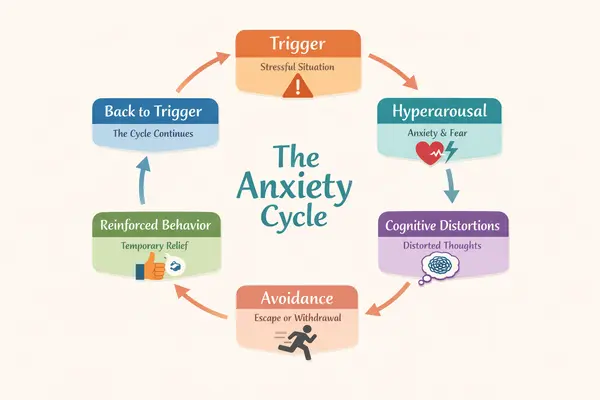
The anxiety cycle is a self-reinforcing loop that keeps anxiety alive and growing. Most people think of anxiety as an emotion that just happens to them — but it's actually a pattern of thought, physical sensation, behavior, and relief that teaches the brain to stay on high alert.
The reason it's so hard to break isn't weakness or a lack of willpower. It's neuroscience. Each time you go around the cycle, the brain receives a signal that the avoidance "worked," which makes it more likely you'll avoid again next time. Over time, the anxiety gets stronger, the avoidance gets broader, and your world gets smaller.
Understanding the cycle matters because it takes the mystery and shame out of the experience. It's not a personal flaw. It's a predictable pattern — and predictable patterns can be changed. I want to help you take control of your anxiety instead of letting your anxiety controlling you.
The Six Stages of the Anxiety Cycle
Stage 1: The Trigger
Everything starts with a trigger. A trigger is any situation, thought, memory, physical sensation, or environment that the brain has tagged as potentially threatening. Triggers can be obvious — a job interview, a conflict with a partner, a school presentation. But they can also be surprisingly subtle: a tone of voice, a certain smell, an unexpected change in plans, or even a quiet moment alone where the mind starts racing.
For men, common triggers often center around performance, control, or perceived failure — a work deadline, financial stress, feeling disrespected, or health concerns. For teenagers, triggers frequently involve social dynamics, academic pressure, fear of embarrassment, or uncertainty about the future.
What makes anxiety triggers particularly sticky is that the brain doesn't always need the actual event to fire the alarm. A thought about the event is often enough. The anticipation of a difficult conversation can feel just as threatening as the conversation itself.
Related: Understanding your teen's anxiety triggers — National Institute of Mental Health
Stage 2: Hyperarousal — Your Body Sounds the Alarm
Once the brain perceives a threat — real or imagined — the nervous system kicks into fight-or-flight. This is called hyperarousal, and it's where anxiety becomes physical.
You might notice a racing heart, tightened chest, shallow breathing, sweaty palms, a knot in your stomach, or a feeling of restlessness you can't shake. For some people, it's a sudden burst of irritability. For others, it's a kind of mental static — the inability to concentrate on anything except the thing they're worried about.
This physical alarm response is hardwired into human biology. It was designed to help you outrun a predator, not navigate a parent-teacher conference. The problem is that the nervous system doesn't distinguish between physical danger and emotional threat. It responds the same way to both.
For men who are used to handling stress physically — at the gym, at work, through action — this stage can feel particularly frustrating when there's nothing to "do." For teens, the hyperarousal stage often looks like agitation, emotional outbursts, or physical complaints like stomachaches and headaches before school.
Stage 3: Cognitive Distortion — The Brain Starts to Lie
When the nervous system is in high-alert mode, thinking changes. The brain under anxiety is not operating with clear, balanced logic. It's in survival mode — scanning for threats, assuming the worst, and catastrophizing.
This is the stage of cognitive distortions: the mental shortcuts and exaggerations that anxiety uses to convince you the threat is real and serious. Common distortions include:
- All-or-nothing thinking: "If I mess this up, everything falls apart."
- Catastrophizing: "What if this gets worse? What if I can't handle it?"
- Mind-reading: "Everyone thinks I'm weak / failing / falling apart."
- Fortune-telling: "I already know this is going to go badly."
- Personalization: "This is happening because of something I did."
For teens, cognitive distortions often sound like "everyone hates me," "I'm the only one who feels this way," or "I'll never be able to do this." These thoughts feel completely true in the moment, even when they aren't.
The cruel irony of this stage is that the more anxious you become, the more convincing the distortions feel. The brain in hyperarousal is flooded with stress hormones that actively impair the prefrontal cortex — the part responsible for rational thinking. So the anxiety literally gets in the way of thinking your way out of the anxiety.
Stage 4: Avoidance — The Escape Hatch
With the body alarmed and the mind convinced danger is near, avoidance feels like the logical move. And in the short term, it works. You cancel the plans, avoid the conversation, stay home from the event, call in sick, or let your teenager stay home from school "just this once" — and the anxiety fades. Relief arrives.
Avoidance takes many forms. It's not always as obvious as refusing to leave the house. It can look like:
- Scrolling your phone instead of tackling the thing you're dreading
- Over-preparing and rehearsing to feel in control
- Drinking to take the edge off social situations
- Letting your teen play video games all day to avoid the argument about school
- Avoiding doctors, conversations about finances, or any topic that might confirm a fear
- Procrastinating on decisions so you don't have to sit with uncertainty
For parents, avoidance sometimes looks like accommodation — removing every obstacle your teen might face in an effort to protect them from discomfort. The intention is care. But the effect, as we'll see, is that it feeds the cycle.
Related: How avoidance maintains anxiety — American Psychological Association
Stage 5: Reinforced Behavior — The Relief That Backfires
This is the hinge of the entire cycle. When avoidance produces relief, the brain registers it as a success. The behavior gets reinforced — meaning the brain learns: avoidance = safety. The next time a similar trigger appears, the pull toward avoidance is stronger.
This is called negative reinforcement. You're not rewarded with something good — you're rewarded by the removal of something bad (the anxiety). And negative reinforcement can be just as powerful as any positive reward, sometimes more so.
Here's what the research tells us: the relief from avoidance is always temporary. The anxiety doesn't go away — it waits. And every time you avoid, the brain gets one more data point confirming that the situation is too dangerous to face. The feared thing grows more threatening in your mental model, not less.
For teens, this pattern can escalate quickly. A single avoided school day becomes three, then a week, then a pattern. Each avoided day makes the return feel more impossible. The same is true for adults with social anxiety, performance anxiety, health anxiety, or any other flavor of the cycle.
What's particularly painful about this stage is that the person often knows, on some level, that avoidance isn't helping. But knowing and doing are governed by different parts of the brain — and when the nervous system is in survival mode, it overrides rational awareness every time.
Stage 6: Back to the Trigger
The cycle doesn't end with relief. It resets. The avoided situation doesn't disappear — it comes back. The next email, the next school morning, the next social event, the next doctor's appointment. And now the nervous system is even more sensitized to it than before.
This is why untreated anxiety tends to worsen over time rather than resolve on its own. The cycle turns faster and becomes harder to interrupt. The triggers multiply as the brain generalizes — if public speaking is dangerous, maybe all large groups are dangerous. If one test caused a panic, maybe all academic performance is threatening.
The good news is that understanding the cycle is itself a disruption. Once you can see the pattern, you can make a different choice at each stage. And with the right support, those different choices become new neural pathways — the brain can literally learn a different response.
Why Men Often Miss the Signs
Anxiety in men frequently goes unrecognized — both by the men themselves and by the people around them. The cultural narrative that men should be stoic, capable, and self-sufficient means many men never label what they're experiencing as anxiety. Instead, it shows up as:
- Chronic irritability or anger that seems disproportionate
- Withdrawing from family and relationships
- Overworking as a way of feeling in control
- Physical symptoms like chronic headaches, GI issues, or insomnia
- Excessive drinking or substance use to manage tension
- A general sense of "always being on edge" without knowing why
Many men who come to my practice have been managing anxiety for years without ever naming it. They thought they were just stressed, or wired that way, or not handling things well. Understanding the cycle — and recognizing how it's been operating in their specific lives — is often the beginning of real change.
Recognizing the Anxiety Cycle in Your Teen
Teens are experiencing anxiety at historically high rates, and the cycle often looks different in adolescents than it does in adults. Parents frequently describe watching their teenager become someone they don't recognize — withdrawn, explosive, avoidant, or seemingly indifferent.
I have been working with teens for 20 years, so I have seen lots of ways anxiety manifests itself: panic attacks, school avoidance, isolation in their rooms, and leaving the things they once enjoyed. I've worked with public and private school kids, so I understand the unique pressures of the schools. My office is close to UCO, Edmond North and Sequoyah Middle School.
Some signs the anxiety cycle may be active in your teen include:
- Refusing to attend school or social events they used to enjoy
- Excessive reassurance-seeking ("Are you sure everything is okay?")
- Complaints of stomachaches, headaches, or other physical symptoms before stress-inducing situations
- Explosive reactions to small stressors
- Spending increasing amounts of time in their room or on devices
- Difficulty sleeping or sleeping far more than usual
- Persistent "what ifs" and worst-case-scenario thinking
One of the most important things I talk with parents about is the difference between supporting your teen and inadvertently reinforcing the avoidance cycle. When we remove every difficult thing from a teen's path to reduce their discomfort, we send the message — unintentionally — that they can't handle hard things. That message feeds the anxiety, not the teen's confidence.
This doesn't mean pushing teens into situations that overwhelm them. It means finding the right level of supported challenge — and that's exactly the kind of individualized work that happens in therapy.

How Treatment Works: Breaking the Cycle
There is no single path to breaking the anxiety cycle. Every person's history, nervous system, and situation is different. What I focus on with each individual is understanding where the cycle has the most traction in their specific life, and what approach will create the most meaningful shift.
That said, there are well-established, evidence-based strategies that work.
Cognitive Behavioral Therapy (CBT) for Anxiety
CBT is one of the most thoroughly researched treatments for anxiety disorders. It works by targeting two of the most influential stages of the cycle: cognitive distortions and avoidance behavior.
In CBT, I work with clients to identify the specific thought patterns that are driving their anxiety — the catastrophizing, the mind-reading, the fortune-telling — and learn to challenge and reframe them. This isn't about thinking positively. It's about thinking accurately. Most anxious thoughts, when examined carefully, don't hold up.
The behavioral component involves gradually and systematically facing avoided situations rather than escaping them. This is called exposure, and it's perhaps the most powerful tool available for breaking the avoidance reinforcement loop. Done in a supported, paced way, exposure teaches the nervous system something it genuinely doesn't know yet: that the feared situation is survivable, manageable, and often far less threatening than anticipated.
For teens, CBT is adapted to be practical, relatable, and skills-based — focused on tools they can actually use in real time when anxiety spikes.
I offer both in-person sessions in Edmond, OK and online sessions for those who prefer the flexibility of working from home.
When Talk Therapy Isn't Enough: Neurofeedback for Resistant Anxiety
For some people, talk therapy alone doesn't fully resolve the anxiety. They understand the cycle intellectually. They know their thoughts are distorted. They can name the patterns. But the nervous system keeps firing anyway. The body stays on high alert even when the mind knows better.
This is where neurofeedback becomes a valuable option — and it's one of the tools I offer in my practice for clients who need a different approach.
What Is Neurofeedback?
Neurofeedback is a non-invasive, drug-free approach that works directly with the brain's electrical activity. During a session, sensors are placed on the scalp to monitor brainwave patterns in real time. You receive immediate feedback — typically through audio or visual cues — that helps guide your brain toward calmer, more regulated states.
The goal is not to relax you artificially. The goal is to train the brain to regulate itself more effectively. Neurofeedback focuses on the central nervous system to improve neuroregulation and stabilization — and modulation of brain activity can drive genuine behavioral changes. (NCBI, 2017)
Research suggests neurofeedback may be particularly helpful for people with generalized anxiety who experience chronic hyperarousal — which maps directly onto Stage 2 of the anxiety cycle. When the nervous system's baseline level of arousal is brought down, the cycle has less fuel.
Who Is Neurofeedback For?
Neurofeedback may be worth exploring if:
- You've tried talk therapy and feel you've hit a ceiling
- You understand your anxiety cognitively but can't seem to change how your body responds
- You don't want medication, or medication hasn't been effective
- Your anxiety involves significant physical symptoms (racing heart, sleep disruption, chronic tension)
- You prefer a more body-based, brain-based approach to healing
It's also an option I offer for teens — particularly those for whom sitting and talking feels difficult, or whose anxiety has a strong physical or somatic component. The sessions are engaging rather than conversation-heavy, which some teens find more accessible.
Neurofeedback works by strengthening neural pathways associated with emotional regulation while weakening those linked to anxious arousal. Over time, with consistent sessions, clients often notice that their baseline anxiety is lower, their triggers are less intense, and they recover more quickly when anxiety does arise.
It's important to say that neurofeedback is not a replacement for understanding the cycle or developing coping skills — it's best used as part of a personalized, integrated approach. Together, CBT and neurofeedback address both the mind and the nervous system, which is often where lasting change happens.
Key Takeaways
- The anxiety cycle has six stages: trigger, hyperarousal, cognitive distortion, avoidance, reinforced relief, and return to trigger
- Each time the cycle completes, the anxiety becomes stronger and more resistant to change
- Avoidance provides real but temporary relief — and teaches the brain that the feared thing is dangerous
- Men often experience anxiety as irritability, withdrawal, or physical symptoms rather than overt fear
- Teens caught in the avoidance cycle may need supported challenge, not just protection from difficulty
- CBT addresses the thoughts and behaviors driving the cycle; neurofeedback addresses the nervous system directly
- No single treatment is right for everyone — personalized care matters
- Breaking the cycle is possible, and the first step is understanding how it works
Frequently Asked Questions
Mild anxiety tied to a specific stressor often resolves once the situation passes. But anxiety that is caught in the avoidance cycle tends to grow rather than resolve, because the cycle reinforces itself each time it completes. Without interrupting the pattern, the nervous system learns to stay alert. If anxiety has been affecting your life for more than a few weeks, it's worth speaking with a professional to assess what's happening and what might help.
This is one of the most common questions I hear from parents. All teenagers avoid things they don't want to do. The distinction is whether the avoidance is causing meaningful impairment — missed school, loss of friendships, inability to engage in activities they used to enjoy, or significant distress. If the avoidance is escalating and interfering with your teen's development, an evaluation is a wise next step.
Yes, though it's adapted based on the person. With adults, CBT tends to be more insight-oriented and structured. With teens, I focus on practical skills, relatable language, and tools they can actually use in the moment. The underlying framework is the same — identify distortions, practice facing avoided situations, build tolerance for discomfort — but the delivery looks different.
Stress is typically a response to an external pressure that resolves when the pressure does. Anxiety tends to persist beyond the stressor and often attaches to multiple situations over time. If you're worrying even when things are relatively calm, or if the worry feels disproportionate to the actual situation, that's a signal that anxiety has taken hold.
This varies significantly from person to person, which is why I don't believe in one-size-fits-all timelines. Some people notice meaningful shifts within the first few sessions of CBT. Neurofeedback typically requires a longer commitment — often 20 or more sessions — before full effects are realized, though many clients notice early changes within the first 10. The best way to get a realistic sense of what to expect is to have an honest conversation during an initial session about your specific situation and goals.
You Don't Have to Stay Stuck in the Cycle
The anxiety cycle is powerful — but it's not permanent. Understanding how it works is genuinely the first step toward changing it. Once you can see the trigger, the alarm, the distorted thinking, and the avoidance for what they are — a learned pattern, not a life sentence — something shifts. The cycle becomes visible, and visible patterns can be interrupted.
Whether you're a man who's been white-knuckling through stress for years without naming it, or a parent watching your teenager shrink further from the life they deserve, there is a path forward. It's not the same path for everyone, and it shouldn't be. The work I do is individualized — rooted in understanding your specific history, nervous system, and goals, then building a plan that actually fits.
I work with clients in person at my Edmond, OK office and online for those who need flexibility. If you're ready to stop letting anxiety run the show, reach out and let's figure out together what breaking the cycle looks like for you.
Ready to break the anxiety cycle — for yourself or your teen?
I offer both in-person sessions in Edmond, OK and online sessions across Oklahoma.
Contact me today to inquire about availability and get started.
If this article resonated, share it with a parent, a partner, or a friend who might be caught in a cycle they can't quite name yet. What part of the anxiety cycle do you recognize most in yourself or your teen? Sometimes just seeing the pattern described clearly is the beginning of everything.
References
- National Institute of Mental Health. (2023). Anxiety Disorders. https://www.nimh.nih.gov/health/topics/anxiety-disorders
- American Psychological Association. (2023). Anxiety. https://www.apa.org/topics/anxiety
- Medical News Today. (2024). Anxiety and avoidance behaviors: Causes and management. https://www.medicalnewstoday.com/articles/anxiety-avoidance
- NCBI Bookshelf. (2017). Neurofeedback and Biofeedback for Mood and Anxiety Disorders: A Review of Clinical Effectiveness. https://www.ncbi.nlm.nih.gov/books/NBK531603/
- Han, Y., et al. (2021). Neurofeedback training improves anxiety trait and depressive symptom in GAD. Brain and Behavior. https://pmc.ncbi.nlm.nih.gov/articles/PMC7994677/