

Building Breakthroughs: How Legos Helps Preteens Talk
Play therapy for preteens | Brick-based therapy | Child counseling in Edmond, OK
Summary: Traditional talk therapy can feel like an interrogation for preteens. By using Lego bricks as a therapeutic tool, we remove the pressure of direct eye contact and "on-demand" sharing, allowing kids to communicate through their hands and navigate complex emotions at their own pace.
If your preteen shuts down the moment you mention therapy, you are not alone. Most kids between the ages of 9 and 13 would rather do just about anything than sit across from a stranger and talk about their feelings. The idea of traditional talk therapy — where they are expected to look someone in the eye, answer questions, and open up on command — can feel uncomfortable, even threatening, for a lot of kids this age.

That is exactly why I started using Lego in my sessions with preteens. What I have found, across more than 20 years of working with kids and teens in Edmond, OK, is that when you give a preteen something to do with their hands, the conversation starts to happen naturally. There is no spotlight. There is no pressure. There are just bricks — and suddenly, a kid who would not say a word is telling me everything.
Play can open doors that regular talk therapy may be locked out of.
This article is for parents who are curious about how play-based approaches can support their preteen's mental health, and specifically how something as familiar as Lego can become a powerful tool in therapy. We will cover what brick-based therapy actually looks like in a session, why it works for kids with anxiety and ADHD, how it connects to evidence-based approaches like CBT and ACT, and what you can expect if your child starts working with me.
Why Preteens Are So Hard to Reach in Traditional Therapy
The preteen years sit in a strange in-between space. Kids this age are moving away from the imaginative, open-ended play of early childhood, but they are not yet comfortable with the kind of self-reflection that adult therapy often requires. They are also navigating a surge of self-consciousness — acutely aware of how they are perceived, sensitive to judgment, and often skeptical of adults who want to talk about their feelings.

For many preteens, being asked to sit still, make eye contact, and talk about what is bothering them can feel like being put on trial. Anxiety spikes. Walls go up. Silence fills the room.
This is not a character flaw. It is developmental. And it is one of the main reasons I lean into play-based approaches for this age group. When we shift the focus away from the child and toward a shared task — like building something together — the dynamic in the room changes entirely. The child stops feeling like the subject of examination and starts feeling like a collaborator. That shift alone changes what becomes possible in a session.
What Brick-Based Therapy Actually Looks Like
Using Lego in therapy means treating the bricks as a purposeful tool rather than just a distraction or reward. The bricks become a kind of shared language between me and the child. Instead of asking a preteen "How does anxiety feel for you?" I might ask them to build what anxiety feels like. Instead of talking through a conflict they had with a friend, we might use figures and structures to map it out in three dimensions.
Instead of talking about how to deal with anger, we can imagine a Lego character is struggling with anger. We can help him find ways to deal with his anger, then apply those strategies to our lives.
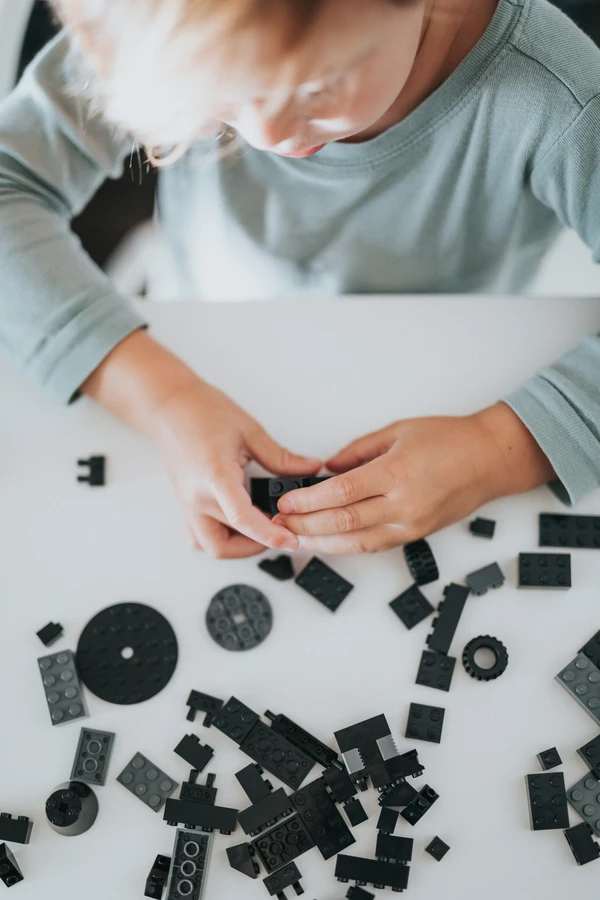
What makes this so effective is that it removes the pressure of direct disclosure. The child is talking about their creation, not directly about themselves — but often, the two are exactly the same thing. I have been impressed with some of the insights my younger clients have had during brick-time. Kids who would not answer a single direct question will spend forty-five minutes telling me, through their builds, everything I needed to know.
Building a project each week gives some preteens something to look forward to in therapy, too.
Learn more about how play therapy supports child development →
The Science Behind Why Lego Works in Therapy
There are several reasons why Lego bricks work well in therapeutic settings with preteens.
Tactile engagement supports regulation. The repetitive, hands-on nature of connecting bricks provides sensory input that helps regulate the nervous system. For kids dealing with anxiety or ADHD, having something to do with their hands keeps them grounded and present. The structured, predictable nature of Lego — where the bricks always connect in the same way — can help organize thinking and reduce overwhelm for kids who struggle with attention or impulsivity.
Non-eye-contact play lowers the pressure. When two people are building side by side instead of sitting face to face, the social pressure drops. Eye contact can feel confrontational to a kid who is already on edge. Shifting the gaze to a shared object levels the playing field and makes conversation feel less like an interrogation.
Creative expression gives kids a safer route to communication. Many preteens have learned to guard their words carefully. They know that saying the wrong thing can lead to more questions, more concern, more attention on them. Building something gives them a way to communicate that feels safer. Over time, those builds become a genuine window into what they are carrying.
Familiarity reduces therapy anxiety. Lego is something many kids associate with fun, creativity, and mastery. Walking into a therapy office and seeing a tub of bricks on the table sends a message right away: this place is safe, and what happens here might actually be okay.
How Lego Play Connects to CBT and ACT
In my practice, I draw primarily from Cognitive Behavioral Therapy (CBT) and Acceptance and Commitment Therapy (ACT) — two well-researched approaches for anxiety, ADHD, and emotional regulation in young people. Lego play does not replace these frameworks; it works alongside them in a way that makes them accessible for kids who would otherwise tune out.
CBT helps kids identify thought patterns that are driving anxiety or difficult behaviors and practice replacing them with more balanced thinking. When a preteen builds a representation of a stressful situation, we can look at it together and ask: what is this structure telling us? What story is the builder telling themselves? This gets the thought pattern out of their head and into the room, which is exactly what CBT work is designed to do. We can then start working on how to rebuild it differently — both in bricks and in thinking.
ACT focuses on helping kids identify what they value and commit to action that aligns with those values, even when anxiety or discomfort shows up. I sometimes ask preteens to build something that represents what matters most to them, or what they want their life to look like. When they have built it themselves, it becomes real and personal in a way that a worksheet rarely achieves.
What This Looks Like for Preteens with Anxiety
Anxiety in preteens often shows up differently than it does in younger children. You might see it as avoidance — refusing to go to school, dropping activities they used to love, or shutting down socially. You might see it as irritability, stomachaches, or sleep problems. And you might see it as a strong reluctance to talk about any of it.
In sessions, Lego gives anxious preteens a way to approach their fears at a pace they control. A child who is anxious about social situations might build a scene involving peers and narrate what is happening in it — which gives us exactly the material we need to work through those fears without ever putting the child on the spot. We can explore what happens next in the build as a way of asking what they predict will happen if they try something in real life — a core CBT technique, delivered through play.
Over time, the skills we practice in session translate to real tools your child can use when anxiety spikes at school or in a social situation.
For more on anxiety in preteens, the Child Mind Institute offers excellent resources for parents →
What This Looks Like for Preteens with ADHD
For kids with ADHD, the challenge in traditional therapy is often that sitting still and talking feels like the exact opposite of how their brain wants to work. They are wired for movement, stimulation, and engagement. Asking them to sustain a focused conversation without any physical outlet and then expecting breakthroughs is a tall order.
Lego changes that equation. Building provides a physical task that channels energy and provides just enough sensory stimulation to keep an ADHD brain engaged without becoming overwhelming. Many of my ADHD clients may be distracted during therapy, but can lock in during brick-building time. So we can have a longer, more focused conversation than we would otherwise.
In my sessions with kids who have ADHD, Lego becomes a vehicle for working on impulse control, task persistence, frustration tolerance, and flexible thinking — all without it feeling like a clinical exercise. When a build goes wrong and pieces fall apart, we process that together: what happened, how it felt, what we do next. Those moments in a therapy session are rehearsals for real-life resilience.
The Non-Eye-Contact Advantage: Why Side-by-Side Matters
This is something I want parents to understand, because it is one of the most underappreciated parts of working with preteens this way. Direct eye contact during a difficult conversation is not a neutral act for most kids this age. It registers as scrutiny. It triggers self-consciousness. For kids who are already anxious or carrying shame around their struggles, being watched while they talk can shut everything down.
You have probably discovered it is sometimes easier to have conversations with your preteen when you are in the car. You are avoiding eye contact, so they tend to lower their guard. It is the same way when I build Legos with my clients. Both of us are looking at the same thing — the creation in front of us. The child's face is not under observation. There is something to look at that is not each other, and that changes everything about how freely a preteen will talk.
Bridging Lego Play and Real-Life Skills
What happens in the therapy room only matters to the extent that it connects to a child's real life. The skills we work on through Lego — identifying and naming emotions, tolerating frustration, communicating needs, thinking flexibly, building resilience when things do not go as planned — are not abstract. They are the exact skills your preteen needs to navigate friendship conflicts, academic pressure, family tension, and the general ups and downs of growing up.
As our work together develops, the goal shifts from using the bricks to express and process, to building a toolkit your child can carry with them. CBT-based coping strategies for anxiety. ACT-informed approaches to sitting with discomfort instead of avoiding it. Communication skills that work in the real world.
The Lego is a bridge. And eventually, your child will not need the bridge quite as much — because they will have built something sturdier inside themselves.
What to Expect: Starting Therapy with Your Preteen
I know that starting the therapy process can feel uncertain, especially when your preteen is resistant. Here is a brief look at how I typically approach new clients.
The intake process begins with me meeting with both parents and the preteen together to understand the goals and concerns from everyone's perspective. This initial meeting sets the tone — it communicates to your child that they are not being handed off, and that their voice matters. From there, I work to understand each child as an individual. There is no one-size-fits-all plan, and the approach will be shaped specifically around your child's needs, strengths, and what they are dealing with.
Once care is established, sessions focus on developing the practical skills and tools your preteen needs to manage anxiety and navigate the challenges they are facing. We build on what is working, adjust what is not, and keep everything connected to your child's actual life.
I offer both in-person sessions in Edmond, OK, and online sessions for families who prefer or need that flexibility. I do not work with insurance directly, but I am happy to provide documentation that may support reimbursement through your plan. For questions about fees and scheduling, please reach out through my website — I am glad to talk through what makes sense for your family.
Conveniently Located in the Heart of Edmond
My office sits within a triangle formed by three landmarks most Edmond families know well — the University of Central Oklahoma (UCO), Sequoyah Middle School, and Edmond North High School. If you have kids in this part of town, chances are you drive through this area regularly.
For families near those schools, the location is genuinely convenient. If your teen is a brisk walker, they could actually walk to my office from Sequoyah Middle School or Edmond North High School after the school day. That kind of accessibility can make a real difference when you are juggling after-school schedules and trying to fit regular therapy appointments into the week without a major detour.
Whether you are dropping your child off between activities, stopping by after school pickup, or simply looking for a therapist who is easy to get to from your neighborhood near UCO, the location works well for a lot of Edmond families. And for those who are farther out or simply prefer to stay home, online sessions are always an option.
Why 20 Years of Experience With Teens Makes a Difference
Working with adolescents and preteens is a specialty, not a default. Over the past 20 years, I have learned that this age group requires a fundamentally different approach than working with younger children or adults. Preteens can tell immediately when an adult is patronizing them or not actually listening. They are good at detecting when they are being managed rather than heard.
What I have developed over two decades is a genuine comfort with this age group — an ability to be in the room with them without making them feel like a case to be solved. I know how to be curious without being intrusive, direct without being threatening, and patient without being passive. And I know when the bricks are the point, and when they are just the doorway.
If your preteen has been reluctant about therapy before, I understand. The right fit and the right approach can make all the difference. Learn more about my practice at englandtherapy.com →
Key Takeaways for Parents
- Lego play in therapy is intentional, not incidental. It is a purposeful tool that lowers barriers and opens communication for preteens who struggle with traditional talk therapy.
- Non-eye-contact, side-by-side play changes the dynamic in the room. For kids with anxiety, ADHD, or just typical preteen self-consciousness, this shift matters enormously.
- Brick-based work connects directly to CBT and ACT. The play is not separate from the therapy — it is the therapy, grounded in evidence-based approaches.
- The goal is real-life skills, not just in-session breakthroughs. Your child should leave our work together with actual tools for managing anxiety and navigating challenges.
- Every child's path looks different. The approach is tailored to your preteen's specific needs, strengths, and goals.
- Experience with this age group matters. Twenty years of working specifically with teens and preteens means I know how to meet your child where they are.
- Both in-person sessions in Edmond and online sessions are available, so scheduling does not have to be a barrier.
Frequently Asked Questions
Q: My preteen says they don't want to go to therapy. How do Lego-based sessions help with that resistance?
Resistance is very common with this age group, and it usually comes from fear — fear of being judged, fear of being figured out, or fear that therapy means something is seriously wrong with them. Framing sessions around a hands-on activity like Lego can lower that initial resistance significantly. Most kids, once they experience a session that does not feel like an interrogation, find that resistance softening on its own. I work carefully to build trust before pushing into anything difficult.
Q: Is this just playing with Lego, or is real therapeutic work happening?
Both — and that is the point. The play creates the conditions for real therapeutic work to happen. The Lego is not the goal; it is the vehicle. Through the building process, we are actively working on emotional identification, cognitive reframing through CBT, values clarification through ACT, communication skills, and anxiety coping strategies. The bricks are directed in service of those goals.
Q: My child has been diagnosed with ADHD and anxiety. Is this approach appropriate for both?
Yes, and the combination of ADHD and anxiety is actually one where brick-based approaches can be especially helpful. The tactile, hands-on engagement supports focus and regulation for ADHD, while the low-pressure, non-confrontational nature of the activity reduces the anxiety response that direct conversation often triggers. The approach I take is always individualized — your child's specific profile shapes how we use the materials and what we focus on.
Q: How long does it typically take to see progress?
This varies from child to child, which is why individualized care matters so much. Some preteens begin opening up within the first few sessions; for others, it takes longer to build trust and safety. Progress also looks different depending on your goals — it might show up as your child talking more openly at home, using a coping strategy on their own, or simply seeming less anxious before a situation they used to dread. I keep the goals clear and trackable so we can assess progress together.
Q: Do you offer online sessions? My preteen is pretty screen-fatigued — will that work?
I do offer online sessions, and I understand the screen fatigue concern. For online work, I adapt the approach so that your child can use their own Lego at home during sessions — which adds something meaningful, since they are building in their own space with their own materials. Many preteens find this surprisingly engaging. That said, if your child strongly prefers in-person, my office is easy to get to from much of the Edmond area, sitting right between UCO, Sequoyah Middle School, and Edmond North High School.
Let's Keep the Conversation Going
If this article resonated with you — if you recognized your preteen in any of what I described, or if you have been wondering whether a different kind of approach might reach your child where other things have not — I would love to hear from you.
Reach out through englandtherapy.com to learn more about getting started, ask questions about the intake process, or inquire about fees and availability. You can also share this article with another parent who might be asking the same questions — because the more parents understand what is possible for this age group, the more kids get the support they actually need.
What surprised you most about how Lego can be used in therapy? Drop a comment below or share this with a parent who might need to read it.